Showing posts with label health. Show all posts

Sunday, 16 November 2014

4 Ways Excess Fat Makes You A Ticking Time Bomb

Fat, or adipose, tissue was traditionally known as a passive source of stored energy. However, fat is now known to also be a very active endocrine organ, able to produce hormones that play a significant role in the body and have an impact on overall health. While this function is normal within individuals with a healthy body fat percentage, the function of fat cells as an endocrine organ becomes altered with high body fat levels, contributing to the development of metabolic syndrome, insulin resistance, and type 2 diabetes. It is very important to understand the risk factors associated with excessively high body fat percentage.

1. Fat Gain Signals Inflammatory Response

body fat, body fat percentage, bmi, adipose tissue, dangers of body fatAdipose tissue is composed of white fat cells, which contain a large lipid droplet surrounded by cytoplasm with the nucleus on the periphery. When excessive fat is gained, these fat cells increase to four times their original size before dividing into new cells. Fat gain also alters the normal secretion of certain molecules throughout the body. While the exact mechanism is unclear, studies suggest that excessive adipose tissue can initiate an acute inflammatory response.6 Bone-marrow derived immune cells respond by infiltrating adipose tissue, and releasing certain molecules that can induce changes in fat cell activity and lead to chronic inflammation.6 This immune and fat cell activity cause downstream effects that can significantly affect your health when excessive adipose tissue exists in your body. Some of these effects are explained in further detail below.

2. Fat Cells Release Inflammatory Factors

Tumor Necrosis Factor α (TNF-α) is an inflammatory molecule released from adipose tissue. Overweight and obese individuals secrete TNF-α in greater amounts, contributing to insulin resistance.3 TNF- α down regulates GLUT-4, which is responsible for transporting glucose into skeletal muscle, resulting in reduced insulin function. TNF- α also reduces the activity of the insulin receptor, diminishing insulin’s metabolic effects and potentially leading to muscle insulin resistance.5

Interleukin-6 is another molecule released in greater amounts from excessive adipose tissue. Like TNF-α, IL-6 also down regulates GLUT-4, further reducing insulin function and contributing to insulin resistance. Increased IL-6 concentrations also induce the liver to release excess amounts of C-reactive protein (CRP) and fibrinogen in the blood, which are two of the major risk factors for cardiovascular disease and type 2 diabetes.6 IL-6 also increases the concentration and activity of blood platelets, which increases the risk for blood clots.2 The activity of cells that line the blood vessels, such as endothelial cells and smooth muscle cells, is also affected by high IL-6 levels, contributing to vascular wall inflammation and damage.4

3. Fat Cells Cause Plaque Formation

Fat stores also affect your health by reducing the fat cell’s secretion of the anti-atherogenic, anti-inflammatory protein, plaque build up, plaque formation, adiponectin, excess body fatadiponectin. This protein’s main function is to inhibit the buildup of adhesion molecules along blood vessel walls that lead to plaque formation. Adiponectin concentrations decrease as adipose tissue accumulates, placing you at greater risk for plaque formation, cardiovascular disease, and insulin resistance.3  Researchers believe TNF-α may be one of the contributing factors to the decrease in adiponectin concentrations.6

4. Fat Cells Can Become "Sick"

To further illustrate the dangers of accumulating excessive fat stores, a study by Bodenet al. (2008) in the Diabetes journal suggests fat cells from obese individuals are “sick,” due to significantly higher levels of stress to the cell. The authors explain that a constant influx of excess calories into fat cells can induce stress to the endoplasmic reticulum (ER), which is responsible for synthesizing lipids for storage. This stress triggers ER stress sensors, which activate various pathways in the body to alleviate stress. Researchers believe that this ER stress may be a contributor to the inflammation and insulin resistance associated with diabetes.           

In conclusion, adipose tissue does much more than only serve as an energy source. Fat cells are very active, able to communicate with immune cells and initiate an inflammatory response with excess calorie storage. Both fat and immune cells secrete various inflammatory factors that negatively influence normal and healthy functions of the body. As these responses become chronic with significant fat gain, you are at greater risk for chronic inflammation, cardiovascular disease, insulin resistance, and diabetes. Therefore, no matter how active you are, it is important to keep your body fat percentage at a reasonable level in order to maintain long-term health.

References:
1. Boden, G. et al., Increase in Endoplasmic Reticulum Stress-Related Proteins and Genes in Adipose Tissue of Obese, Insulin-Resistant Individuals.  Diabetes, 2008. 57: p. 2438-2444.
2. Burstein, S.A. et al., Cytokine-induced alteration of platelet and hemostatic function. Stem Cells, 1996. 14: p. 154-162.
3. Diamond, A.S. et al,The Endocrine Function of Adipose Tissue. GGH, 2002. 18(2): p. 17-23.
4. Wassmann, S. et al., Interleukin-6 induces oxidative stress and endothelial dysfunction by overexpression of the angiotensin II type 1 receptor.Circ Res, 2004. 94: p. 534-541.
5. Weisberg S.P. et al., Obesity is associated with macrophage accumulation in adipose tissue. J Clin Invest, 2003. 112: p. 1796-1808.
6. Wisse, B.E., The Inflammatory Syndrome: The Role of Adipose Tissue Cytokines in Metabolic Disorders Linked to Obesity.J Am Soc Nephrol, 2004. 15: p. 2792-2800.

Monday, 3 November 2014

3 Reasons Sleep Benefits Your Heart


Winston Churchill, Napoleon, Albert Einstein and Thomas Edison were all known to enjoy naps throughout the day. They likely knew what many of us so easily overlook: sleep improves alertness, mood and performance.
Yet only two-thirds of Americans get enough sleep to feel their best, according to a poll by the National Sleep Foundation. (Global data on sleep is not as easy to find, but I am confident people in other countries have similar issues to the U.S.) This sleep deficit is partially because sleep can seem like the easiest thing to sacrifice in our busy lives. Yet sleep can have a big impact on not only how you feel but also how your body functions. Getting plenty of shuteye has a profound impact on overall health—especially the heart. Here are three reasons why:

 1. Sleep activates the body’s repair mechanisms

Sleep is a time of restoration and repair. While you sleep, your body works to heal and repair your heart and blood vessels. Getting the recommended eight hours of sleep nightly gives your body the precious repair time it needs.

 2. Sleep allows your heart to “rest”

While your heart beats 24 hours a day, seven days a week, sleep is the time it slows down and “rests.” Heart rate declines during sleep, producing a natural drop in blood pressure. Lower blood pressure means your heart doesn’t have to work as hard to pump blood throughout the 100,000 miles of blood vessels in your body.

 3. Sleep improves oxygenation

Sleep promotes oxygenation—a process that increases oxygen in all of the body’s systems—at a deep level. Your heart is responsible for circulating blood to all of the organs, tissues and cells. Since oxygen is necessary to keeping the heart—and entire body—well, this improved oxygenation is key in supporting heart health.

Sleep is just as important as eating a balanced diet and exercising. While every person is unique in how much sleep they need, a good general guideline is to get eight hours of quality sleep each and every night.

Do you get enough sleep each night? What helps you sleep better?


Friday, 5 September 2014

Personal Training 101: How you get energy; how you use it


We usually talk of energy in general terms, as in “I don’t have a lot of energy today” or “You can feel the energy in the room.” But what really is energy? Where do we get the energy to move? How do we use it? How do we get more of it? Ultimately, what controls our movements? The three metabolic energy pathways are the phosphagen system, glycolysis and the aerobic system.How do they work, and what is their effect?
Albert Einstein, in his infinite wisdom, discovered that the total energy of an object is equal to the mass of the object multiplied by the square of the speed of light. His formula for atomic energy, E = mc2, has become the most recognized mathematical formula in the world. According to his equation, any change in the energy of an object causes a change in the mass of that object. The change in energy can come in many forms, including mechanical, thermal, electromagnetic, chemical, electrical or nuclear. Energy is all around us. The lights in your home, a microwave, a telephone, the sun; all transmit energy. Even though the solar energy that heats the earth is quite different from the energy used to run up a hill, energy, as the first law of thermodynamics tells us, can be neither created nor destroyed. It is simply changed from one form to another.
ATP Resynthesis
The energy for all physical activity comes from the conversion of high-energy phosphates (adenosinetriphosphate—ATP) to lower-energy phosphates (adenosine diphosphate—ADP; adenosine monophos- phate—AMP; and inorganic phosphate, Pi). During this breakdown (hydrolysis) of ATP, which is a water-requiring process, a proton, energy and heat are produced: ATP + H2O —© ADP + Pi + H+ + energy + heat. Since our muscles don’t store much ATP, we must constantly resynthesize it. The hydrolysis and resynthesis of ATP is thus a circular process—ATP is hydrolyzed into ADP and Pi, and then ADP and Picombine to resynthesize ATP. Alternatively, two ADP molecules can combine to produce ATP and AMP: ADP + ADP —© ATP + AMP.
Like many other animals, humans produce ATP through three metabolic pathways that consist of many enzyme-catalyzed chemical reactions: the phosphagen system, glycolysis and the aerobic system. Which pathway your clients use for the primary production of ATP depends on how quickly they need it and how much of it they need. Lifting heavy weights, for instance, requires energy much more quickly than jogging on the treadmill, necessitating the reliance on different energy systems. However, the production of ATP is never achieved by the exclusive use of one energy system, but rather by the coordinated response of all energy systems contributing to different degrees.
1. Phosphagen System
During short-term, intense activities, a large amount of power needs to be produced by the muscles, creating a high demand for ATP. The phosphagen system (also called the ATP-CP system) is the quickest way to resynthesize ATP (Robergs & Roberts 1997). Creatine phosphate (CP), which is stored in skeletal muscles, donates a phosphate to ADP to produce ATP: ADP + CP —© ATP + C. No carbohydrate or fat is used in this process; the regeneration of ATP comes solely from stored CP. Since this process does not need oxygen to resynthesize ATP, it is anaerobic, or oxygen-independent. As the fastest way to resynthesize ATP, the phosphagen system is the predominant energy system used for all-out exercise lasting up to about 10 seconds. However, since there is a limited amount of stored CP and ATP in skeletal muscles, fatigue occurs rapidly.
2. Glycolysis
Glycolysis is the predominant energy system used for all-out exercise lasting from 30 seconds to about 2 minutes and is the second-fastest way to resynthesize ATP. During glycolysis, carbohydrate—in the form of either blood glucose (sugar) or muscle glycogen (the stored form of glucose)—is broken down through a series of chemical reactions to form pyruvate (glycogen is first broken down into glucose through a process called glycogenolysis). For every molecule of glucose broken down to pyruvate through glycolysis, two molecules of usable ATP are produced (Brooks et al. 2000). Thus, very little energy is produced through this pathway, but the trade-off is that you get the energy quickly. Once pyruvate is formed, it has two fates: conversion to lactate or conversion to a metabolic intermediary molecule called acetyl coenzyme A (acetyl-CoA), which enters the mitochondria for oxidation and the production of more ATP (Robergs & Roberts 1997). Conversion to lactate occurs when the demand for oxygen is greater than the supply (i.e., during anaerobic exercise). Conversely, when there is enough oxygen available to meet the muscles’ needs (i.e., during aerobic exercise), pyruvate (via acetyl-CoA) enters the mitochondria and goes through aerobic metabolism.
When oxygen is not supplied fast enough to meet the muscles’ needs (anaerobic glycolysis), there is an increase in hydrogen ions (which causes the muscle pH to decrease; a condition called acidosis) and other metabolites (ADP, Pi and potassium ions). Acidosis and the accumulation of these other metabolites cause a number of problems inside the muscles, including inhibition of specific enzymes involved in metabolism and muscle contraction, inhibition of the release of calcium (the trigger for muscle contraction) from its storage site in muscles, and interference with the muscles’ electrical charges (Enoka & Stuart 1992; Glaister 2005; McLester 1997). As a result of these changes, muscles lose their ability to contract effectively, and muscle force production and exercise intensity ultimately decrease.
3. Aerobic System
Since humans evolved for aerobic activities (Hochachka, Gunga & Kirsch 1998; Hochachka & Monge 2000), it’s not surprising that the aerobic system, which is dependent on oxygen, is the most complex of the three energy systems. The metabolic reactions that take place in the presence of oxygen are responsible for most of the cellular energy produced by the body. However, aerobic metabolism is the slowest way to resynthesize ATP. Oxygen, as the patriarch of metabolism, knows that it is worth the wait, as it controls the fate of endurance and is the sustenance of life. “I’m oxygen,” it says to the muscle, with more than a hint of superiority. “I can give you a lot of ATP, but you will have to wait for it.”
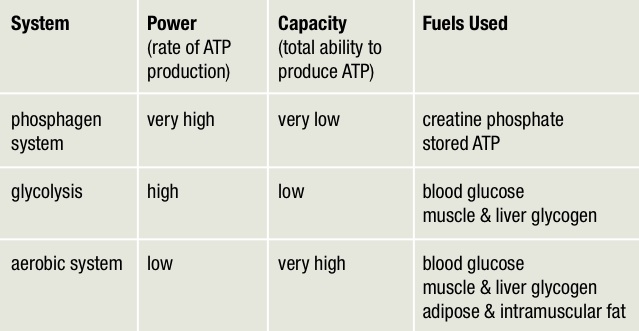
The aerobic system—which includes the Krebs cycle (also called the citric acid cycle or TCA cycle) and the electron transport chain—uses blood glucose, glycogen and fat as fuels to resynthesize ATP in the mitochondria of muscle cells (see the sidebar “Energy System Characteristics”). Given its location, the aerobic system is also called mitochondrial respiration. When using carbohydrate, glucose and glycogen are first metabolized through glycolysis, with the resulting pyruvate used to form acetyl-CoA, which enters the Krebs cycle. The electrons produced in the Krebs cycle are then transported through the electron transport chain, where ATP and water are produced (a process called oxidative phosphorylation) (Robergs & Roberts 1997). Complete oxidation of glucose via glycolysis, the Krebs cycle and the electron transport chain produces 36 molecules of ATP for every molecule of glucose broken down (Robergs & Roberts 1997). Thus, the aerobic system produces 18 times more ATP than does anaerobic glycolysis from each glucose molecule.
Fat, which is stored as triglyceride in adipose tissue underneath the skin and within skeletal muscles (calledintramuscular triglyceride), is the other major fuel for the aerobic system, and is the largest store of energy in the body. When using fat, triglycerides are first broken down into free fatty acids and glycerol (a process called lipolysis). The free fatty acids, which are composed of a long chain of carbon atoms, are transported to the muscle mitochondria, where the carbon atoms are used to produce acetyl-CoA (a process called beta-oxidation).
Following acetyl-CoA formation, fat metabolism is identical to carbohydrate metabolism, with acetyl-CoA entering the Krebs cycle and the electrons being transported to the electron transport chain to form ATP and water. The oxidation of free fatty acids yields many more ATP molecules than the oxidation of glucose or glycogen. For example, the oxidation of the fatty acid palmitate produces 129 molecules of ATP (Brooks et al. 2000). No wonder clients can sustain an aerobic activity longer than an anaerobic one!
Understanding how energy is produced for physical activity is important when it comes to programming exercise at the proper intensity and duration for your clients. So the next time your clients get done with a workout and think, “I have a lot of energy,” you’ll know exactly where they got it.
For the latest research, statistics, sample classes, and more, "Like" IDEA on Facebook here.
SIDEBAR: Energy System Characteristics
SIDEBAR: Energy System Workouts
Have clients warm up and cool down before and after each workout.
Phosphagen System
An effective workout for this system is short, very fast sprints on the treadmill or bike lasting 5–15 seconds with 3–5 minutes of rest between each. The long rest periods allow for complete replenishment of creatine phosphate in the muscles so it can be reused for the next interval.
  • 2 sets of 8 x 5 seconds at close to top speed with 3:00 passive rest and 5:00 rest between sets
  • 5 x 10 seconds at close to top speed with 3:00–4:00 passive rest
Glycolysis
This system can be trained using fast intervals lasting 30 seconds to 2 minutes with an active-recovery period twice as long as the work period (1:2 work-to-rest ratio).
  • 8–10 x 30 seconds fast with 1:00 active recovery
  • 4 x 1:30 fast with 3:00 active recovery
Aerobic System
While the phosphagen system and glycolysis are best trained with intervals, because those metabolic systems are emphasized only during high-intensity activities, the aerobic system can be trained with both continuous exercise and intervals.
  • 60 minutes at 70%–75% maximum heart rate
  • 15- to 20-minute tempo workout at lactate threshold intensity (about 80%–85% maximum heart rate)
  • 5 x 3:00 at 95%–100% maximum heart rate with 3:00 active recovery

Wednesday, 25 June 2014

Fact or Fiction: A Sugary Post-Workout Snack Can Be Beneficial


Haribo Starmix


You’ve been told for years to stay away from sugar, that it causes energy crashes, stimulates hunger and in the long run can contribute to weight gain. But numerous magazines and websites urge trainees to consume sugary snacks post workout – including sports drinks and Haribo.
First up, here’s what happens when you eat foods high in sugar. Typically you’ll receive a spike in your insulin level, which is a hormone that carries sugar around in your blood stream. Think of insulin as a taxi or transport system. Many times we eat too much sugar and too much insulin gets released, so your body, in an effort to not go into a dangerous hyperglycemic state, clears all sugar from your bloodstream. And guess what happens when the sugar clears – you end up in a low blood sugar state, get tired and hungry and often reach for more sugar in an effort to wake up. And so the sugar yo-yo cycle continues. I’m sure you’ve all been there!
Now keep in mind the above scenario generally fits with people who eat large amounts of sugar and then sit around, either at work, at home or in the car. However the post workout time frame is a very different story.

Athlete sprint start

During exercise there’s two main things that happen. First, we use up a lot of muscle glycogen and blood sugar for fuel during the workout itself. I’m talking about fairly intense sessions here, you know, the kind I promote here at Angry Trainer Fitness – full body circuits of 30–60 minutes a time. Because you’re using up those precious sugar stores, your body becomes extra sensitive to sugar intake following an intense workout – it’s basically ready to start refueling and gas up the tanks. Remember those insulin ‘taxis’ that carry the sugar around your body? Well during the day and under normal conditions they’re driving around and abiding by the speed limit. But after a workout, they’re ready to go full throttle and race the sugar to the parts of your body that need replenishing. This phase is called ‘heightened insulin sensitivity’ and lasts for about 30–45 minutes max after you workout before returning back to normal levels.
What this essentially means is that you can indeed take in more than normal levels of sugar post workout AND benefit from them, without fear of gaining excess weight. In fact I tell people that if they want a chocolate chip cookie as a treat the best time to eat it is right after a workout! It’ll most likely be used to refuel muscle tissue and it’ll satisfy your cheat.
In fact the more simple the sugar the better! Typically you’ll hear experts urging you to only eat foods that elicit a slow rise in your blood sugar levels. However post workout, we want the exact opposite effect – simple sugars that digest ultra fast and fill the muscle stores up.
Now let me clarify. I’m not suggesting that all of you eat ice cream or cookies after a workout. And depending on your goals, whether they be fat loss or muscle gain, you may want to stay in a low blood sugar state and not consume a sugary post workout meal or drink. It’s all dependent upon your aims. I personally use the post workout shake as the only ‘meal’ in which I get simple sugars. The rest of your day should be made up of fibrous veggies, lean proteins and healthy fats.
Of course if you suffer from any form of diabetes or sugar related issues, you must consult your doctor before you make any changes to your diet. But for those of you that are healthy and looking to get a jump start on the recovery process, some simple sugars right after a workout combined with a scoop of quality whey protein can be just what the doctor ordered!
Fitness Fact Or Fiction… this one’s FACT! 

3 Tips For Optimal Health


Public health is a huge concern of almost everyone in one way or another.  Everyone should try to optimise their own health. Nothing frustrates me more than seeing people struggle with their appearance, mood, mental clarity and energy to name but a few. At the same time their body fat levels show that they are borderline morbidly obese. Doesn’t it strike you as coincidental that more often than not it is fat, overweight people who rarely exercise and eat an inordinate amount of crappy unhealthy food are the one’s with appearance, mood, cognitive, energy and libido issues? More often than not it is these people who are chronically fatigued.  We are supposed to live until 100 years old not suffer from inordinate amounts of disease after just 20 years of life; we all need to work on creating an environment for optimal health.
I experienced parenthood for the last two days and I enjoyed it.  Of course I’m not trying to undermine how difficult it must be to rear kids but I will say that being highly active and eating a good, healthy diet played a big role in why my energy wasn’t zapped. Sleeping in is a luxury for parents with kids of school going age and I am under no illusion that the effects of being a real parent may accumulate over time but eating well and fitting in some exercise when you can will have a profound effect on your ability to stay healthy, energetic and keep in good shape.  Most parents health status is far below optimal I would imagine.
Do you wake up and feel groggy every morning?  Do you claim to need a coffee to get you going?  Do you dread the thought of getting out of bed?  If you answered yes to any of these then you need to make a change (Chek, 2009).
More often than not the reasons for these issues are so obvious it will make you sick. You could be eating foods that don’t work well with your body, not sleeping enough, not exercising, not exercising properly or under a lot of stress.  We are not all designed to eat the same types of food.  As an example; different cars take different types of fuel, right?  What makes you any different to a car?  Fill your body with the wrong type of fuel and it will tell you.  Just because you don’t break out in hives doesn’t mean all food is good for your body. Fatigue is the #1 example of how we react badly to different foods. Do you feel a little sluggish after a particular meal?  If so you will be best served to avoid it.  In my case pasta makes me extremely tired almost immediately after eating it.  Large amounts of low fibre carbohydrates in one sitting generally make me feel bloated and sluggish.  These are my body’s way of telling me it doesn’t want these foods (Chek, 2009).
Handstand Press Up Outdoors

Do You Get Enough Sleep?

Most people underestimate the value of adequate sleep and most people tend not to get enough sleep as it is. For optimal body function you need between 7-9 hours of sleep each night.  You may be saying to yourself you get enough sleep but just because you spend 7-9 hours in bed doesn’t necessarily mean you are getting quality sleep.  Sleep quality is far more important than sleep quantity.  You should not feel groggy after 7-9 hours in bed (Wilson, 2006; Chek, 2009; Holford, 2012).  You should wake up without an alarm and want to get at the day.  Fatigue can induce impaired gluconeogenesis (your body’s ability to use fat and protein for energy), rapid hypoglycemia (low blood sugar), sodium loss and potassium retention (Wilson, 2006). What’s interesting about this situation is due to the stress your body is under, despite having low blood sugar, there tends to be rather high levels of blood insulin meaning you are going to become progressively more overweight and at risk of type 2 diabetes. The net result of these is a miserable, tired feeling.  Small things can make an inordinate amount of difference in the quality of your sleep;
  1. Turn off all electronics.  Yes this includes your phone.  With the advancements in phones of late almost everybody has some sort of notification waiting for them every morning be it from email, twitter, instagram or your ‘hardcore’ friends posting annoying late night Facebook updates and photos.  If you leave your phone on at night your are more likely to be woken.  Turn it off, whatever it is can wait until the morning.  For those of you that use your phones as alarm clocks Invest in an alarm clock (preferably a battery-powered one) (Gooley et al. 2011;Chek, 2009).
  2. Have no lights shining.  That even means covering the red LED from your alarm clock. Get curtains that leave the room in complete darkness.  You may not think it but light from the night sky also affects your sleep quality.  I can never understand how people can sleep without drawing their curtains (I have a few people in mind) (Gooley et al. 2011; Chek, 2009).
  3. Stop playing video games or doing anything that gives your brain a lot of stimulation. You should be winding down an hour before bed.  Ever find that your brain won’t stop going when all you want to do is sleep?  Try and read before bed and dump all your work or college thoughts until the next day. Many people worry about what they have to do tomorrow.  A good technique I have starting doing lately is making a list of everything I have to do in order of priority in the evening.  It is often referred to as a ‘brain dump’, it helps you to forget about what has to be done until the morning (Chek, 2009).
  4. Have a cool room temperature.  This one might sound a bit ridiculous to some of you.  A cold room is far more conducive to high quality sleep than a warm room.  Your body temperature naturally drops through the night. The cooler your body is the better your sleep will be. Try taking a cold shower before bed. This is ideal for anybody that works out late at night.  And no you shouldn’t be wearing socks and a hoody to bed that’s just downright ridiculous.  Unless you live in a house with below freezing temperatures, then you should wear a hat to bed, I’m speaking from experience here from my poor student days.
  5. Eliminate caffeine after 3pm.  I am a culprit for this one myself.  You may think having a coffee after your dinner is not problem as you fall asleep just fine. Again, I come back to the sleep quality issue. You may fall asleep easily but caffeine is a stimulant and will in fact continue to stimulate your central nervous system throughout the night this upsetting your sleep quality (Chek, 2009).
  6. Eliminate high carbohydrate meals 3 hours before bedtime. Remember that carbohydrates cause a large spike in blood sugar which in turn gives you a boost in energy.  Try a moderate protein and fat meal is you want to eat close to bedtime (Richards, 2005).
  7. Go to bed earlier.  Midnight is not a good time to go to bed.  You should be sound asleep by 10.30 at night (Richards, 2005). 

Female sleeping

    Exercise

    Find me someone who exercises PROPERLY and eats relatively well that doesn’t feel good.  Unless they have some other underlying health issue then you won’t find one. Even if you do think you find someone you will never know unless they change their diet and exercise regime to see if it makes them feel better.With regard to exercise let me clarify from the beginning; walking is not exercise, it’s locomotion, meaning it’s something you have to do for life.  If you feel like crap, are tired don’t think walking will fix your problem. Granted it has it’s place for overall longevity but for health & fitness purposes you may as well just stay in bed if walking if your medicine. For those that are short on time, all you need is 10-15 minutes a few days each week. Everyone has this time; it;s just a matter of allocating it to exercise.  You may feel like you don’t want to exercise but you have to force yourself at the beginning.  Examples of the initial benefits for those with chronic fatigue and health complications include (Wilson, 2003; Harrower HR. 1922);

    1. Increased blood flow which helps prevent plaque accumulation in your arteries and stimulates your liver which enables it to perform its 3000+ daily functions more effectively
    2. Exercise will also help to normalise cortisol, insulin, blood glucose, growth hormone, thyroid hormones among others
    3. Drives oxygen to your brain.
    Do some HIIT at home e.g. pick an exercise like burpees, mountain climbers, squat jumps etc, do it as fast as possible for 15-30 seconds, rest for the same time and repeat for 10-12 minutes. Try it out and tell me it was easy.


    Diet

    Your diet is the overall key.  Reduce or eliminate sugary foods e.g. biscuits, cakes, sweets, ice cream, pastries.  Also eliminate poor carbohydrate sources like pasta, white rice, almost all breakfast cereals and most breads (except spelt or rye for example) (Pollan, 2008). Base your meals around proteins such as; chicken, turkey, salmon, tuna, herring, mackerel to name but a few, include a large base of vegetables and highly fibrous, slow releasing carbohydrates such as; quinoa, oatmeal, beans, brown rice, basmati rice and cous cous (Taubes, 2009).  If your main meals are in check then you will see and feel amazing improvements. Make small changes at first and build on them over time rather than instantly changing your entire diet.  Remember that you must aim to eat REAL FOOD.  Things with wrappers and more than three ingredients aren’t food rather they are diseases disguised as food (Gussow, 2003).  Check out this recipe site, that shows you how to cook healthy versions of your favourite desserts.

    Closing Thoughts

    Make some of these changes to your life, you will reap the rewards.  Remember, nobody is asking you to be perfect.  Just make small changes and you will see the benefits.
    1. Sleep Better
    2. Exercise Smarter
    3. Eat Better
    4. Eliminate Needless Stressors in Your Life (This basically encompasses every one of the above four points)

What's Popular Now