Showing posts with label fitness tips. Show all posts

Tuesday, 2 December 2014

What should I do during my rest periods?


rest periods
Squeezing in a gym session around work and your weekend hangover is difficult. When you finally find the time you need to make the most of every minute. That means no chatting up the pilates class and absolutely no #gymselfies! It also means putting your rest periods to better use than sitting on the bench, swiping through Tinder
Rest periods should change in length depending on the aim of your session. If you’re storming through a circuit you only have 30-45secs between sets and need all of that to catch your breath. But if you’re doing strength training and your rep range rarely heads above five, you should be taking a full 3mins of rest. If you don’t, your CNS won’t recover and your subsequent lifts will suffer.
But 3min rests in a 45min workout eats into much needed gym time. Not what you want when you’ve already pushed back meetings and re-arranged date night to carve out a free hour. To help improve your workout's efficiency we've picked our perfect filler moves to supplement your exercises and help you become stronger, more flexible and injury proof.

Deadlifts

You would have thought this ultimate strength move required all of your effort, but a bit of extra abs work can bolster your future performance. “Working on anterior (front) core strength will help you maintain a flat back throughout the lift,” says Mans. Perfect form means you lift with the correct muscles and can squeeze out that final rep with ease. Perform 1min of front planks, side planks or deadbugs between each set for a side-order of six-pack abs and an extra 10kg on your PB.

Back squats

You won't pack any power into your lower body if your 'squats' involve little more than a slight bend at the knee “Poor hip flexibility means you’ll struggle squatting to the necessary depth,” says Mans. Loosening your muscles with flexibility exercises between sets increases your range of movement and therefore your lift's efficiency. Do 30secs of kneeling hip flexor stretches and psoas quad stretches during your breaks. Google them and thank us later.

Bench press

To get the most out of your time at the bench you need to work through your 'sticking point' – that reallly difficult phase of the move where the bar is 3-5 inches from your chest. Wall slides are the perfect stretch to open out your chest muscles, boosting your range of movement and helping ease the bar's journey. “Wall slides are essential, especially if you've been sat hunched over in front of a desk all day,” says Mans. Do 15 reps every time you break from the bench. They’ll work wonders for your posture and boost your bragging rights.

Shoulder press

Your shoulder is made up of more muscles than you might think. Shoulder stability exercises work the smaller muscles and are essential for overall strength and avoiding injury. “Try 90 degrees external rotation exercises using a cable machine,” says Mans. Set the pin to a light weight and do around 12 reps on each arm. Popping a weak shoulder at the top of a lift won't just hurt like hell, it'll keep you out of the gym for weeks. Don't forget the little guys.

Friday, 28 November 2014

Can't Do Pull Ups? We Have 7 Tips to Get You There

Pull ups are a basic movement in CrossFit, yet in and of themselves they are an intermediate gymnastic movement. Starting out pulling your bodyweight can seem like an insurmountable task.

Don’t fall prey to the mistakes of progressing too fast, kipping before you’re ready, or skipping over the fundamentals. There are tons of strategies and methods of assistance to get your chin over that bar, but not all of them are helping you to get stronger.

Here we will learn where to begin and which alternatives are worth your time. Here are seven tips for achieving that beautiful, dead-hang pull up:

1. Work Your Mobility

Pullups begin as all movements do - with proper mobility. Work on being able to maintain a proper overhead position exactly as described in my article The Safest and Smartest Progression for Building Your Overhead Lifts. If you start with tight lats, chest, or spine you’re already in a compromised position. This will put more stress on your shoulder joint and spine. For a pull up, you must start in a deadhang position with active shoulders. Once you can hang in this position in a controlled manner, then you can start pulling motions.

If you are unable to achieve a proper active hang position, you can still start building strength while working on your mobility. Work on grip strength using heavy deadlifts along with farmer’s carries. Both will stress the forearm and hands in a similar way to a pull up. To begin building pulling strength, you can do bent over barbell or dumbbell rows. Both are effective at building pulling strength and require less mobility to perform correctly.

2. Get Some Hang Time

Once you open up the mobility to dead hang properly, then you need to start spending time on the bar. Dead hangs for time are an effective way to build shoulder stability and grip strength. Make sure you never let your form suffer during these.

3. Avoid Jumping and Rubber Bands

Jumping pullups and banded pullups are popular in the CrossFit world as a way to get in a workout, but I’ve found little success with these methods and little direct translation into actual pull up strength. Strict banded pullups can be decent for building strength, but during a metcon they get abused and people begin to kip, bounce out of the hole, and squirm in all sorts of ways to finish their reps. If you’re after metabolic conditioning, switch to rows, deadlifts, rowing, ring rows, or some other variation.

4. Build Strength

To get your first pullup what you want to do is build strength. This means operating at 80%+ of your max effort at a minimum. Ring rows are one of the most effective methods to build strength and are easily varied in intensity by changing your positioning. Mark your foot positioning each workout and begin to creep your body closer to parallel with the floor each time. This will increase the load by involving a greater percentage of your bodyweight.

Negative pullups are also effective at building strength. Start with a five-second controlled descent and build to longer durations of time. Eccentric work can be very taxing and leave you sore, so start conservatively and add on as your body tells you. Don’t combine a lot of eccentric pulling work and then a hard metcon involving similar movements.


5. Stay Focused

Remember the body can adapt well in one way at a time. It’s hard to increase strength and endurance at the same time. This is why we cycle our training and have times when we focus on strength and times when we focus on conditioning. If your goal is to do a pull up, then focus on getting that first one now, and then multiple reps later.

6. Resist the Kip

Don’t kip until you can do at least five strict pullups. Kipping is the translation of horizontal momentum to vertical force and allows you to do a greater number of pull ups. Kipping is more efficient, but it also loads the shoulder dynamically, putting more force on it. If you are unable to control your bodyweight, there is no reason to add momentum on top of that.

7. Climb a Rope

Another movement great at building pulling strength is rope climbs. Rope climbing with efficiency involves using your legs to hook the rope and push yourself higher. Your arms hold you in place as you bring your legs up. So for a rope climb you only need to be able to hang on, not just pull your way to the top. Therefore, this is a great tool for people still working on building their pulling strength. If you’re a beginner, though, remember to let your legs help you so you don’t just focus on your arms and get burned out.

Respecting the pullup, training for your current ability level, and listening to your body will yield long-term results. If you’ve never done a pull up, then it’ll take time to get there, but the long smooth road always beats the ups and down of overtraining and progressing too quickly.

The Female Guide to Getting Lean

So many times women ask me, "How can I lose this?" while they're pinching whatever area they want gone. While no one is exactly the same, there are a few general tips that I can throw out there for you that do the trick whether you're leaning up for aesthetic or performance reason.

Calorie Intake

If you weigh 200lbs and are only eating 1,200 calories, you are not eating enough. That doesn't mean break out the donuts, that means increase your protein consumption – to start. A general guide for calorie intake is your bodyweight times ten to twelve. Example: 200lbs x 10 = 2000 cal.

bodyfat, female athlete, bodybuilding, getting lean, cutting weightYou may be thinking this is a lot of food, but it is not. Women have been taught that starving themselves will make them lose weight. In reality, we don't just want to be smaller do we? Don't we want to be leaner, too? I'm not saying bodybuilding lean, but enough to see a little definition in your arms and/or abs. Most women would answer me with a very loud, “Yes!”

Calorie intake is just one component of many that go into this machine we call our body. The body is much smarter than the average person. You may trick it once or twice, but it will learn how to overcome what you are trying to do to it. The body will combat under eating by hording everything you feed it. Then you jump on a piece of cardio equipment and pedal your little heart out for extensive amounts of time, and still - nothing. Why is that? Keep reading!

Drop the Carbs Down

You don't have to completely eliminate them; doing so would only set you up for failure. Do you even know how many you get in a day? Do you have a food log? Are you logging on a site like Fitday.com or MyFitnessPal.com? Do you know what foods are considered high in carbohydrates?
          
The foods to reduce in this category would be sugar, which includes candy, cakes, pies, etc. But it also includes fruit. I hear so many people say how healthy they eat and then proceed to tell me they load up on fruit. Fruit is mostly sugar. Natural sugar is still sugar, and it still makes you fat if you eat too much of it. Okay, so we have sugar clarified. More foods that are sugary: pasta, potatoes, some other veggies - research those. Don’t forget rice and bread are sugary, too.

bodyfat, female athlete, bodybuilding, getting lean, cutting weightAnother misconception is that brown rice and pasta and whole grain breads don't do the same thing as their regular white counterparts. Truth is - they do. They just have a little more fiber and digest more slowly, so you don't get quite the same insulin spike, but they are still a carb and they can still cause fat gain if you overeat them.

So what we have learned is to drop carbs down. In general, I start people out at 25-30% carbohydrates in their diet and assess from there. How are you going to do that if you don't know how many sugars and carbohydrates are in what you're eating? Start logging your food on one of the sites I mentioned above. Take responsibility for what goes in your mouth.

Increase Your Protein and Don’t Fear Fat

Beef, chicken, turkey, fish, etc. There are studies out now that are proving our governments “lean meat only” consumption isn't necessary.

For example:

  • CLA is a substance that accumulates in the fat of grass-fed ruminant animals-fats like butter and tallow-that has anti-cancer effects.
  • Industry apologists have now done an about-face and are campaigning against the trans in favor of the liquid oils - while using this opportunity of heightened public interest to continue demonizing the fats we should all be using, the natural saturated animal fats in animal foods and tropical oils.

Increased protein helps maintain the lean mass (muscle) you already have. You want to keep this, as it increases your metabolism. Adding a little more lean mass is usually a good thing. As a general starting point, I think 40% of daily food intake should be protein. I have seen great results with this.

Resistance Training

Ladies, listen very closely: you will not bulk up from resistance training. If you start getting bigger, it is most likely because you are also eating more. You may put on a little lean mass, but it should not cause you to outgrow your pants. In fact, if you clearly know what foods are acceptable, watching your nutrition, and doing resistance training, you should be getting smaller and leaner.

Just because you workout doesn't mean it's time to go get a pizza because you “just worked off the calories.” It's simple, if you have a high body fat percentage, you are eating too much, unless there are medical reasons surrounding your weight in which case you should be even more attentive to your food intake.

Resistance training has some proven benefits:

  • Improved muscle strength and tone
  • Weight management
  • Prevention and control of health conditions such as diabetes, heart disease and arthritis
  • Pain management
  • Improved mobility and balance
  • Improved posture
  • Decreased risk of injury
  • Increased bone density and strength
  • Reduced body fat
  • Boosted metabolism
  • Improved sleep patterns
  • Increased self-esteem
  • Enhanced performance of everyday tasks

A Little Cardio Goes a Long Way

bodyfat, female athlete, bodybuilding, getting lean, cutting weightWomen today go way overboard with cardio. I have a simple explanation for what this does to your body. It is well known to those of us in the industry that excessive cardio (meaning more than 45 minutes steady state or 30 minutes of high intensity interval training) is too much for the average person. After this amount of time, your body will start to become catabolic, which means it starts to eat muscle for fuel instead of food recently eaten and fat stores. All those ladies you see on the cardio equipment day after day, who always look the same, are actually eating up their muscle.

Do you realize what this means? They are lowering their metabolism because now they have less lean mass. Basically, if you would give them a body composition test, they would be fatter.

Becoming catabolic also happens when we don't eat enough. Starving yourself will only make you carry more fat. When you can't stand starving yourself anymore and go back to “normal” eating, don't expect a positive result. All the scam diets that tell you to drink nothing but shakes or eat only five hundred calories a day, they make you catabolic and set you up for failure. Don't be lazy. Take control of your body.

All of it comes back to being balanced and approaching your health and fitness from a variety of angles. While these guidelines are general, they work and they are a great place to start whether your goals are athletic or aesthetic. Cardio, strength, and nutrition are all important and all build upon each other. Focusing too much on any one aspect while leaving others at the wayside won’t have you be the best athlete you can be

Sunday, 16 November 2014

The 5 Training Mistakes You Need to Avoid After 35

Aging, if done correctly, is full of beauty, comedy, wisdom and enlightenment. It’s a great ride with plenty of ups and downs. You can save yourself years of trouble, pain, and calamity by accepting that successful people adapt to aging, that the rules of biology apply to you, and that education is your best friend.
 
By all means, do not go gently into that good night, just make sure you rage against the dying of the light with the one thing we all forget to use in the beginning: our heads. Here’s are the top five training mistakes made after turning 35 and how you can avoid them.
 

1. You Still Believe You Can Do It Like You’re 25

We all know that the personal record days coming off a pizza-and-beer all-nighter are over. But even when we clean up our diet and lifestyle, we still want to train like we did when we were in our twenties. With all the same volumes, rep schemes, intervals, and non-recovery days, and all the sexy programs we see in the magazines and on the Internet.
 
This makes no sense. And you know it because you feel like shit and can’t “keep up” with “those damn kids” anymore.
 

aging, mature athlete, mistakes, volume, sitting, comparison, moving
 
Science tells us our metabolism is slowing down, it takes longer to recover (recovery is the unsexy place where growth happens in training) and changes in sleep patterns and circadian rhythms occur, which means you will probably sleep less at night and not sleep as deeply. All bad news for training.
 
So what do you do during this transitional period? Easy. Grow up.
 

2. You Still Think More Is Better

More training is not better. Smarter training and more recovery is better. Understanding this is vital to your continuous improvement.
 
Your training program must be a progression toward your goal, whatever that goal may be. Yes, training can absolutely have the appearance of randomness, but it absolutely cannot be randomly programmed. 
 

"More training is not better. Smarter training and more recovery is better."

Periodization in an intelligent must-have. Your program must allow for the proper rebuilding of broken-down tissue between sessions. This takes longer as you age, and you’re best off seeking the help of a professional when it comes to programming. Programming is as much art as it is science.
 
Mechanics and body alignment (i.e. mobility), as well as technique, play a huge role in your training sessions as joints age. Joint pain is not okay and is, in fact, a biomarker for injury. Don’t be afraid to seek out new strategies and new techniques. Play. Experiment. Adapt. Overcome.
 
Remember, abundance and complications are the way of youth. Quality and simplification are the challenge of adulthood. Think on this. Apply it to your training.
 

3. You Have No Respect for the Most Insidious Device Invented

This piece of equipment drives sedentary behavior, is practically unavoidable for most of us; is a major cause of those tight sensations in our hips and hamstrings; weakens our stabilizing muscles; ruins posture; increases the risk of cardiovascular disease, high blood pressure, diabetes and obesity; and has been linked to cancer, depression and a shorter life expectancy.
 
It is most likely right under your ass right now. It’s called a chair. How’s your posture right now?
 
Want to blow your own mind? Take a random day in your workweek and time yourself. How many hours did you spend sitting? Include your relaxation time at home. Now, before you decide to run out and be that treadmill-desk person, try a little management of the problem instead.
 
aging, mature athlete, mistakes, volume, sitting, comparison, moving

 
Start by getting up and moving around a little more throughout your day. Walk down to your coworker’s office instead of shooting an email. Cut your TV time down by a third. Have a team meeting with everyone standing or go for a walk and talk.


"Start by getting up and moving around a little more throughout your day." 

Your legs are the big movers. The contractions of these muscles increase fuel consumption and will mediate the collection of high levels of blood sugar in the bloodstream due to inactivity. This is a good thing. Move your big movers.
 

4. You Have Yet to Grasp Situational Awareness

Remember in college when you were so busy? What’s your reaction now when a twenty-something tells you how busy he or she is? Exactly.
 
There are many factors in your life that did not exist before now: children, bills, unexpected bills due to children, a job with increased responsibility and leadership roles, more stress, more relationships to manage, more creative and innovative opportunities, more responsibilities at home, more decisions to make each day and less time to make them, more stress, less sleep, and fewer hours in the day to be selfish.
 
This all must be accounted for in your training. Your training log should include a record of your stress level, how much sleep you got, and if you stayed on track with your diet. It doesn’t have to be a complicated log. Record them all on a scale of 0 to 3. Zero is horrible. Three is excellent.
 
The truth is there are no bad days training if you just accept that sometimes life is going to get in your way. Do what you can with what you have where you are.
 
Only have time for a quick warm up and 3 x 5 on the back squat today? Own it. Only have thirty minutes for your run? Do a light five-minute warm up and four sets of hard running for three minutes, rest for three minutes.
 

5. What and Who You Compare Yourself to Is All Wrong

It is dangerous when you compare your numbers and your look to the professionals who do it for a living or the person next to you in the gym who is ten to twenty years younger. These people do not have the same life as you. They don’t have the same responsibilities, complications, or genetic traits as you. You are not comparing apples to apples. You are being a juvenile idiot.
 

aging, mature athlete, mistakes, volume, sitting, comparison, moving
 
By all means, have goals, but respect that you’re not “who you were back then.” You’re not even who you were yesterday. You are you, right now, and the only person you should compare yourself to is you. Period.
 

Have Fun With Your Fitness

You must acknowledge that immediate gratification plays no role in your evolution, so enjoy the pursuit of a disciplined practice in the art of fitness. Have fun! Eliminate pressure. If you do this, you will learn that fitness can offer a lot more than just aesthetics and statistics.
 
And it will be these lessons that ensure your life will be full of grace, beauty, comedy, wisdom, and enlightenment. Avoid all five of these mistakes and you can get to the good stuff much more quickly.

Sunday, 26 October 2014

How to Use the Front Squat to Improve Strength and Performance

I’ve said it before, and I’ll say it again. The front squat is hands-down my favorite exercise. Whenever I say this, it tends to start a front squat versus back squat debate. Which is crazy, as it’s not an either-or situation. 

But I will say that for an athlete who wants to get all-around strong, steer clear of injury, and maximize carry over into strength sports, the front squat offers a number of advantages.


Why Do Front Squats

In my article When in Doubt, Do Front Squats: 25 Tips for Better Front Squats, I explain:

  • From a coaching perspective - Front squats are easier to teach, more self-correcting, and promote better depth. 
  • From an injury prevention perspective - Front squats are kinder on the shoulders, and incur less shear forces and compressive forces.
  • From an athletic perspective - Front squats facilitate awesome core strength and have incredible carry over into other strength movements. This is not just strength-wise, but in terms of position and mechanics, too.
 
For Olympic weightlifters, the front squat is the best movement for learning the squat clean bottom position. Weightlifting coach Bob Takano explains why in his article Hitting Bottom: 3 Tools to Perfect Your Olympic Lifts:

The best movement for learning the squat clean bottom position is the traditional front squat. This movement performed with an optimal amount of weight will force the body into the bottom position, while simultaneously stretching the tendons and ligaments involved in achieving the position. At this point the front squat is not a strengthening exercise, but a positioning and stretching exercise.
 
For powerlifters, the front squat can be valuable as an assistance exercise to the back squat. For strongmen, the front squat ties in very well to positions within the sport, such as sitting with a Atlas stone on your lap, ready to drive the stone up and onto the platform (pictured below). For CrossFitters, it also has carryover to other movements within the sport, such as thrusters and wall balls.


So let’s take a deeper look at the movement itself, why you might want to perform it, and variations on the standard barbell front squat.
 

How to Perform the Front Squat

For those less familiar with this movement, strength and conditioning coach Traver H. Boehm provides a demonstration and basic explanation in his video on the front squat.


If you prefer a written format, read through this great basic skill review by Breaking Muscle founder, Mindith Rahmat from her article Deconstructing the Front Squat:

  • Take time to find your starting position.
  • Find your natural foot stance width your feet slightly wider than shoulder width apart and your toes slightly out so your toes can follow the path of your knees.
  • Find your grip on the barbell slightly wider than shoulder width.
  • Receive the bar from the rack on the front of the shoulders and step back onto the platform.
  • Keep chest up and raise the elbows high.
  • Stabilize the midline taking in a deep breath.
  • Keep the feet flat on the ground pushing down through the heels.
  • Squat down until the thighs are below parallel.
  • Keep the chest up, back tight, and the elbows high when coming out the squat aggressively drive the elbows up to come out of the hole.
 

How to Improve the Front Squat

When people ask me how they can improve their front squat, they are disappointed when I don’t reply with something secret and Russian. Rather, I’ll ask to have a look at their front squat. The first place to look for improvement is within the movement, every time.

I’ve written two articles to specifically help you with this. For technical tips on the front squat, check out When in Doubt, Do Front Squats: 25 Tips for Better Front Squats – and I’m only half joking about the “when in doubt do front squats” bit.

"The first place to look for improvement is within the movement, every time."

Another way of creating improvement within the movement is to regress the movement down to even simpler forms. In this light, take a look at Squat Therapy: 4 Drills for a Better Squat. Squat therapy will improve your squats through the fact it is formed of four self-correcting movement drills. You are grooving good movement simply by performing the drills.


From regressions, we can move onto variations. Let's take a look at two variations of the movement, and how they compare to the clean grip barbell front squat.

Crossed Arm Grip

Strength coach Jesse Fernandez explains how this variation works in his article A Primer on Front and Back Squats: Crossed-Arm, Clean Grip, Low Bar, and High Bar:

Place the bar in front of your shoulders, resting it directly on top of your deltoids, just as you with clean grip version. You then will cross your hands over the bar, making an “X” when looked at from up above. Elbows will face forward and arms will be parallel to the ground

Why would you vary the grip? It’s a great question. There is less carryover to the clean with crossed arms. Also it’s not actually that easy to secure the weight like this. However, if you or your client has wrist issues, or other mobility or injury issues restricting him or her from performing a standard front squat rack, this is a useful way of facilitating the benefits of the front squat without rack position being the limiting factor in terms of weight.

If clean grip was the ultimate goal, then the root causes of the inability to get into a clean grip rack position must be addressed in parallel.


Left: Clean grip; Right: Crossed arm grip.

Two-Kettlebell Front Squat

This is an incredibly humbling movement. Strength and conditioning coach James Cerbie gives us an example of his client’s experiences with this movement in his article The 2-Kettlebell Front Squat: The Best Exercise You're Not Doing

“Well, that sucked.” My client un-racked the kettlebells and put them on the ground, still contemplating how in the world he got crushed by such little weight (comparatively speaking of course).
 
Here I was taking this guy who considered himself to be pretty strong (and to his credit he was - he could do a mid-300lb front squat relatively easily), and putting him on the struggle-bus with a pair of 24kg kettlebells.


James also lists some key reasons for performing this movement:

  • Lower body strength – The increased instability of the kettlebells compensates for the lack of load.
  • Core stability – This exercise puts your core on overdrive and forces you to maintain position.
  • Grooving the pattern - The previous two points combine to make this movement an effective variation for grooving the squat pattern.
  • Breathing into your back - By biasing a little flexion in the bottom of the squat, we can work on good breathing technique.

The article goes on to list how to perform the movement, possible technique flaws, modifications, and even programming – it’s well worth a read.

I hope this article has also been well worth your read. Now, read it again, pick out some points to practice, go do some front squats. Then come come back here and let me know how you got on.

Wednesday, 15 October 2014

How to Adjust Sets and Reps to Fit Your Training Goal


The way we describe a workout is by breaking it down into exercises, sets, and repetitions. All of your workout can be explained in only a few lines and all will understand what those numbers and multiplication signs mean.

The Importance of Number of Repetitions

Early on, you learned about repetitions. You learned the number of reps you do depends upon your training goal. You do singles, doubles, and triples for power; sets of four, five, or six for strength; eight to twelve reps for hypertrophy; and sets of fifteen or more for endurance.

(As an aside after all the many years I have spent around gyms I have never seen any trainee doing sevens. Ditto on thirteens and fourteens. I guess we just like to work with round or familiar numbers.)


How to Categorize Sets For Lifters and Bodybuilders

The way you categorize sets is somewhat different than reps. They, too, depend on your training goals, but they also depend on where you are at in your workout. Most trainees regardless of discipline use between three to eight work sets. These are the down-and-dirty sets that help you work toward accomplishing your goals.

It stands to reason that the higher the intensity and the lower your reps per set, the more sets you will have to do. For strength and muscle building, the name of the game is to achieve a certain volume of work in training sessions. For weightlifters or powerlifters, you will not be able to lift more than one rep at 100% intensity, so you will have to do more sets of those singles to get enough work in. Conversely, if you are doing a bodybuilding-type of routine, then three sets is the norm. Due to the high reps, bodybuilders only need to do three sets in order to achieve sufficient training effect.

Approach the Warm Up With Caution

The number of warm-up sets done on the way to work-set territory can vary. Many beginners make the mistake of taking too narrow a step between each set. By the time they get to their work sets, they are showing signs of fatigue and cannot perform at their best. Excess warm up can be a sign of lack of confidence. This is especially seen to be true in competition settings where stress is high and those extra sets pile up quickly.

With practice you can get to the point where you will need few heavier warm-up sets. In that case, a new problem emerges - the psychological difficulty of going from very light to quite heavy all at once. This is like jumping out of a nice warm bed into a cold shower.

The solution is a little thing we call an approach set. This is a weight only a plate or so lighter than the first work set and done for only a single or double. The sole purpose of approach sets is to mentally prepare the lifter for the heavier work weights to come. It is just too much of a shock to the system, especially that mysterious system between the ears, to go from a light warm up to a heavy work set in one jump. The approach set will warn the body and the mind that they are now going to be lifting something a little heavier. After the approach set the first work set will feel a lot better and the lifter will feel more confident.


Ramped Up or Straight Across

Eventually you get to your work sets. The number of reps and sets will depend on your training goals. Special attention should be given to the repetition regimen in your work sets.By that I mean, will sets be ramped up or straight-across?

Ramped up means the weight used in each set increases. A lifter might do 135x5, 155x5, 175x5, 185x5, and top out at 195x5. This approach is generally used by novices who have not yet developed the capacity for many sets at high intensity. This is great for getting newbies into shape and also for anyone coming back after a layoff or injury. As a lifter gets in better shape and more experienced, he or she will need more intensity.

That is where the straight-across sets come into play. At some point our lifter will want to do 195x5 for all five sets (or 195/5x5 as our shorthand puts it). Intermediate and more experienced athletes will need this extra work to produce a training effect. This venerable 5x5 regimen is commonly used in powerlifting, football, and general strength training. It was popularized by Mark Berry in the 1930s and revived by Bill Starr in the 1970s. The only reason such an antiquated routine is still used is simple - it works.

Intensity Versus Volume

Olympic lifters don't use quite as many reps, instead concentrating on singles, doubles, and triples. As you might guess, when you are peaking for competition, the number of reps goes down but the number of sets will have to go up to compensate somewhat.

I say “somewhat” because you cannot substitute intensity for volume perfectly. For example, if you want to move from a 5X5 regimen to one with singles, you cannot do 25 singles at 95-100% intensity. Even Bulgarians will tire well before that. Eight to twelve such lifts are pretty much the maximum. At that point volume will drop off considerably, to the point it may be inadequate to maintain strength in the long run. So, what to do?

Enter the concept of the back-off set. This is where the bar is unloaded by a certain amount that will enable more reps and more sets to be done at a high enough weight to stimulate improvement, but not so much weight that fatigue happens too quickly. Back off sets are often done straight-across until a lifter is satisfied that enough work has been done. Others prefer a sort of reverse pyramid situation where the weight is lowered gradually over several sets. Each set will be a little bit lighter and easier than the last.


Variations on the Classic Rep and Set Schemes

There are other regimens out there, but the ones mentioned are the ones most commonly used today. But they are often done with some variation.

The old pyramid regimen has been around for ages. Often lifters will only pyramid upwards, but sometimes they extend the workout by pyramiding back down again. Still other lifters like to warm up really well, then start at the top and pyramid downwards Whichever way they pyramid they usually end up doing more work than they have to.

There are also hybrid schemes where three sets across at one weight are done and then three more may be done across at a higher weight. This is often done when transitioning from ramping up to straight-across sets. At first the lifter is only capable of one set at the maximum. As the lifter gets in better condition, he or she can do two sets, then three, still ramping up the earlier sets. Eventually, the lifter can do all five sets and ramping up can be forgotten.

A Summary Approach

That’s about it for rep and set basics. An exercise will open with straight-across warm-up sets, then some ramping warm-up sets, an approach set, several work sets, and then maybe finish with some straight-across back-up sets.

The key is to know what each is for and don’t do more than you have to.

Friday, 5 September 2014

Personal Training 101: How you get energy; how you use it


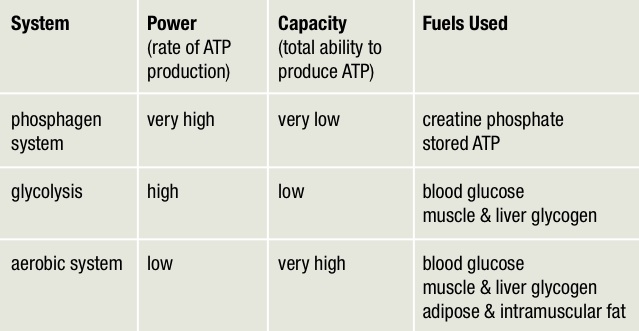
We usually talk of energy in general terms, as in “I don’t have a lot of energy today” or “You can feel the energy in the room.” But what really is energy? Where do we get the energy to move? How do we use it? How do we get more of it? Ultimately, what controls our movements? The three metabolic energy pathways are the phosphagen system, glycolysis and the aerobic system.How do they work, and what is their effect?
Albert Einstein, in his infinite wisdom, discovered that the total energy of an object is equal to the mass of the object multiplied by the square of the speed of light. His formula for atomic energy, E = mc2, has become the most recognized mathematical formula in the world. According to his equation, any change in the energy of an object causes a change in the mass of that object. The change in energy can come in many forms, including mechanical, thermal, electromagnetic, chemical, electrical or nuclear. Energy is all around us. The lights in your home, a microwave, a telephone, the sun; all transmit energy. Even though the solar energy that heats the earth is quite different from the energy used to run up a hill, energy, as the first law of thermodynamics tells us, can be neither created nor destroyed. It is simply changed from one form to another.
ATP Resynthesis
The energy for all physical activity comes from the conversion of high-energy phosphates (adenosinetriphosphate—ATP) to lower-energy phosphates (adenosine diphosphate—ADP; adenosine monophos- phate—AMP; and inorganic phosphate, Pi). During this breakdown (hydrolysis) of ATP, which is a water-requiring process, a proton, energy and heat are produced: ATP + H2O —© ADP + Pi + H+ + energy + heat. Since our muscles don’t store much ATP, we must constantly resynthesize it. The hydrolysis and resynthesis of ATP is thus a circular process—ATP is hydrolyzed into ADP and Pi, and then ADP and Picombine to resynthesize ATP. Alternatively, two ADP molecules can combine to produce ATP and AMP: ADP + ADP —© ATP + AMP.
Like many other animals, humans produce ATP through three metabolic pathways that consist of many enzyme-catalyzed chemical reactions: the phosphagen system, glycolysis and the aerobic system. Which pathway your clients use for the primary production of ATP depends on how quickly they need it and how much of it they need. Lifting heavy weights, for instance, requires energy much more quickly than jogging on the treadmill, necessitating the reliance on different energy systems. However, the production of ATP is never achieved by the exclusive use of one energy system, but rather by the coordinated response of all energy systems contributing to different degrees.
1. Phosphagen System
During short-term, intense activities, a large amount of power needs to be produced by the muscles, creating a high demand for ATP. The phosphagen system (also called the ATP-CP system) is the quickest way to resynthesize ATP (Robergs & Roberts 1997). Creatine phosphate (CP), which is stored in skeletal muscles, donates a phosphate to ADP to produce ATP: ADP + CP —© ATP + C. No carbohydrate or fat is used in this process; the regeneration of ATP comes solely from stored CP. Since this process does not need oxygen to resynthesize ATP, it is anaerobic, or oxygen-independent. As the fastest way to resynthesize ATP, the phosphagen system is the predominant energy system used for all-out exercise lasting up to about 10 seconds. However, since there is a limited amount of stored CP and ATP in skeletal muscles, fatigue occurs rapidly.
2. Glycolysis
Glycolysis is the predominant energy system used for all-out exercise lasting from 30 seconds to about 2 minutes and is the second-fastest way to resynthesize ATP. During glycolysis, carbohydrate—in the form of either blood glucose (sugar) or muscle glycogen (the stored form of glucose)—is broken down through a series of chemical reactions to form pyruvate (glycogen is first broken down into glucose through a process called glycogenolysis). For every molecule of glucose broken down to pyruvate through glycolysis, two molecules of usable ATP are produced (Brooks et al. 2000). Thus, very little energy is produced through this pathway, but the trade-off is that you get the energy quickly. Once pyruvate is formed, it has two fates: conversion to lactate or conversion to a metabolic intermediary molecule called acetyl coenzyme A (acetyl-CoA), which enters the mitochondria for oxidation and the production of more ATP (Robergs & Roberts 1997). Conversion to lactate occurs when the demand for oxygen is greater than the supply (i.e., during anaerobic exercise). Conversely, when there is enough oxygen available to meet the muscles’ needs (i.e., during aerobic exercise), pyruvate (via acetyl-CoA) enters the mitochondria and goes through aerobic metabolism.
When oxygen is not supplied fast enough to meet the muscles’ needs (anaerobic glycolysis), there is an increase in hydrogen ions (which causes the muscle pH to decrease; a condition called acidosis) and other metabolites (ADP, Pi and potassium ions). Acidosis and the accumulation of these other metabolites cause a number of problems inside the muscles, including inhibition of specific enzymes involved in metabolism and muscle contraction, inhibition of the release of calcium (the trigger for muscle contraction) from its storage site in muscles, and interference with the muscles’ electrical charges (Enoka & Stuart 1992; Glaister 2005; McLester 1997). As a result of these changes, muscles lose their ability to contract effectively, and muscle force production and exercise intensity ultimately decrease.
3. Aerobic System
Since humans evolved for aerobic activities (Hochachka, Gunga & Kirsch 1998; Hochachka & Monge 2000), it’s not surprising that the aerobic system, which is dependent on oxygen, is the most complex of the three energy systems. The metabolic reactions that take place in the presence of oxygen are responsible for most of the cellular energy produced by the body. However, aerobic metabolism is the slowest way to resynthesize ATP. Oxygen, as the patriarch of metabolism, knows that it is worth the wait, as it controls the fate of endurance and is the sustenance of life. “I’m oxygen,” it says to the muscle, with more than a hint of superiority. “I can give you a lot of ATP, but you will have to wait for it.”
The aerobic system—which includes the Krebs cycle (also called the citric acid cycle or TCA cycle) and the electron transport chain—uses blood glucose, glycogen and fat as fuels to resynthesize ATP in the mitochondria of muscle cells (see the sidebar “Energy System Characteristics”). Given its location, the aerobic system is also called mitochondrial respiration. When using carbohydrate, glucose and glycogen are first metabolized through glycolysis, with the resulting pyruvate used to form acetyl-CoA, which enters the Krebs cycle. The electrons produced in the Krebs cycle are then transported through the electron transport chain, where ATP and water are produced (a process called oxidative phosphorylation) (Robergs & Roberts 1997). Complete oxidation of glucose via glycolysis, the Krebs cycle and the electron transport chain produces 36 molecules of ATP for every molecule of glucose broken down (Robergs & Roberts 1997). Thus, the aerobic system produces 18 times more ATP than does anaerobic glycolysis from each glucose molecule.
Fat, which is stored as triglyceride in adipose tissue underneath the skin and within skeletal muscles (calledintramuscular triglyceride), is the other major fuel for the aerobic system, and is the largest store of energy in the body. When using fat, triglycerides are first broken down into free fatty acids and glycerol (a process called lipolysis). The free fatty acids, which are composed of a long chain of carbon atoms, are transported to the muscle mitochondria, where the carbon atoms are used to produce acetyl-CoA (a process called beta-oxidation).
Following acetyl-CoA formation, fat metabolism is identical to carbohydrate metabolism, with acetyl-CoA entering the Krebs cycle and the electrons being transported to the electron transport chain to form ATP and water. The oxidation of free fatty acids yields many more ATP molecules than the oxidation of glucose or glycogen. For example, the oxidation of the fatty acid palmitate produces 129 molecules of ATP (Brooks et al. 2000). No wonder clients can sustain an aerobic activity longer than an anaerobic one!
Understanding how energy is produced for physical activity is important when it comes to programming exercise at the proper intensity and duration for your clients. So the next time your clients get done with a workout and think, “I have a lot of energy,” you’ll know exactly where they got it.
For the latest research, statistics, sample classes, and more, "Like" IDEA on Facebook here.
SIDEBAR: Energy System Characteristics
SIDEBAR: Energy System Workouts
Have clients warm up and cool down before and after each workout.
Phosphagen System
An effective workout for this system is short, very fast sprints on the treadmill or bike lasting 5–15 seconds with 3–5 minutes of rest between each. The long rest periods allow for complete replenishment of creatine phosphate in the muscles so it can be reused for the next interval.
  • 2 sets of 8 x 5 seconds at close to top speed with 3:00 passive rest and 5:00 rest between sets
  • 5 x 10 seconds at close to top speed with 3:00–4:00 passive rest
Glycolysis
This system can be trained using fast intervals lasting 30 seconds to 2 minutes with an active-recovery period twice as long as the work period (1:2 work-to-rest ratio).
  • 8–10 x 30 seconds fast with 1:00 active recovery
  • 4 x 1:30 fast with 3:00 active recovery
Aerobic System
While the phosphagen system and glycolysis are best trained with intervals, because those metabolic systems are emphasized only during high-intensity activities, the aerobic system can be trained with both continuous exercise and intervals.
  • 60 minutes at 70%–75% maximum heart rate
  • 15- to 20-minute tempo workout at lactate threshold intensity (about 80%–85% maximum heart rate)
  • 5 x 3:00 at 95%–100% maximum heart rate with 3:00 active recovery

Wednesday, 25 June 2014

Review: Misfit Shine

Misfit Shine
Key Features: Bluetooth 4.0 LE; Waterproof to 50m; Multiple sports tracked; 4-month battery life; No charging or wires required
Manufacturer: Misfit Wearables

Misfit Shine review

What is the Misfit Shine?

The Misfit Shine enters a rather crowded fitness tracking market with a selling point that will stand it apart from the competition – it’s fully waterproof. It’s also an attractive all-metal disc that can be worn anywhere on your body using a dinky little magnetic strip that holds the Misfit Shine in place.

It was launched as an IndieGoGo campaign and achieved its $100,000 project goal 9 ½ hours after it launched. At close, the Misfit Shine had raised its goal eight and a half times over, which just goes to show how interesting the device is.

But can the £99 fitness tracker stand out against its popular rivals?


Misfit Shine Boxed

Misfit Shine – Design and Features

One of the most striking things about the Misfit Shine is its design. Made from aerospace grade aluminium with a distinct groove running around the middle for using the Misfit Shine’s various accessories, it is small, light and compact. Misfit’s choice of material means the Shine only weighs 9g on its own, or 16g with the included wrist strap.

The company, Misfit Wearables, is co-founded by former Apple CEO John Sculley, and there is definitely a touch of Apple in the design of the Shine, especially its simplicity and clean lines. 

Misfit has made sure the Shine can be worn anywhere on the body, and even supplies both the sports band and clasp as standard with the Misfit Shine in the UK from John Lewis. The clasp is a rubber loop with a magnet on one end that folds over to couple with the back of the Shine. You can attach this to any item of clothing, even a swimsuit or shorts as it is completely waterproof to 50 metres. This is also pretty handy if you forget to remove it from your clothes and it happens to take a washing machine trip.

The sportsband is a rubber watch strap that the Misfit Shine simply pops into and is designed to look much more like jewellery than your average fitness tracker, which is one of its key benefits. There’s also a leather strap and a necklace option to purchase separately if you feel the need.

Its waterproof nature and the fact it is so very light means you can pretty much forget about the Misfit Shine when you’re wearing it, especially when it’s strapped to your wrist.

However, it is useful to remember, any fitness tracker worn on your wrist isn’t going to be as accurate as one worn on your clothing as you tend to move your arms more than any other limbs, or you could stop moving them altogether, such as when you’re gripping a bag strap – both of which can cause inaccurate results. This is why Misfit includes the clasp for attaching the Shine to your clothing, which is especially useful when at the gym.

Misfit Shine clipped onto a t shirt

When in sleep mode, the Misfit Shine looks like it has no display at all, but with a double tap on its face you’ll be presented with a ring of LED lights around the edge, which are used to indicate your current goal progress and the time. 

Each LED light is an interval of five minutes or 5 per cent completion of your customised goal. It can be a little difficult at first to work out what time it is (the hour is a solid LED but the minute indicator flashes), but you soon get used to it. Your goal progress is shown in a ring that runs clockwise with your sporting activity until the whole ring of lights is completed, which is a simple but effective way to keep tabs on it without having to look at the app. 

On the rear of the Misfit Shine is a handy 12 logo, to show you which way up the fitness tracker should be placed in your watch strap for accurate clock readings. 

The Misfit Shine connects to the Shine app for iOS devices via Bluetooth 4.0 LE, which doesn’t require pairing. Misfit assures us there’s an Android app coming “in the next few weeks”, but there hasn’t been any joy there as yet.

Bluetooth LE keeps the power consumption low and combined with the fact the Misfit Shine uses a standard cell watch battery with a battery life of at least 4 months, you’ll be using it for ages without having to charge it or replace the battery.

There are some features that are lacking in the Misfit Shine, like an altimeter to count the number of stairs you climb, which features in upcoming trackers like the Fitbit Force.


Misfit Shine – Tracking and Apps

The Shine app is a very simple but effective way of monitoring your daily fitness activity. Periods of activity are shown in colour coded panels that show the type of sport you are doing and low, medium and energetic patches of activity.

There’s a highlights panel that offers you a look at your daily milestones, broken down into a handy activity chart and the aforementioned coloured blocks. You can also take a look at a weekly overview of your activity, which also compares your achievements to the previous weeks. 

Overall, the Misfit Shine is very accurate and can tell when you are performing any of its recognised activities – walking, running, cycling or swimming. It does tend to be far more precise when worn on your clothes, as when on your wrist it can suggest you were more active than you actually were – but that sometimes isn’t a bad thing.

Within the app you can not only personalise your activity goal, but also let it know where you’re wearing the Misfit Shine for more precise data gathering and whether you want the fitness tracker to display the clock or progression lights first. 

You can also utilise the Misfit Labs Activity Tagging. This allows you to triple tap the Misfit Shine to tell it you are doing a specific activity for more accurate readings. Although this feature is still in Beta, you can use it to tell the Shine when you’re sleeping, cycling, swimming, playing tennis, basketball or football and the results are far more accurate – if you remember to triple tap before you start doing them. 


Misfit App Screenshots

The Shine app also presents information on the amount of steps you’ve taken, calories burnt and distance covered in a single day or whole week. 

What is disappointing about the Misift Shine is its sleep monitoring functionality. Unless you tell it you’re going to sleep using the Activity Tagging it won’t monitor your sleep pattern whatsoever. We always forgot to triple tap before we fell asleep so we’d wake up with no data for our slumber. 

When you do remember, it lets you know how many hours of deep sleep you’ve managed to get in between patches of tossing and turning. How accurate this data actually is is very hard to calculate, but they are interesting statistics to peruse in the morning.

As the Misfit Shine uses Bluetooth LE you won’t need to pair it with your smartphone or tablet. When you enter the app, the data automatically updates and fills in all the fitness tracking information since you last logged in. it doesn’t matter whether that’s a week or 5 minutes ago, it is all updated regardless. 

It is very speedy to update, which is a bonus. We will say the data provided is a bit limited, but that’s pretty standard for what is basically a glorified pedometer like its competition. The app is laid out in a straightforward and accessible way and unless you’re a proper fitness freak it is more than sufficient for those looking to monitor their activity.

Misfit App Screenshots

Should I buy the Misfit Shine?

The Misfit Shine is a great activity tracker but is a little more expensive than some of its competitors and currently has limited smartphone and tablet compatibility if you don’t have an iPhone or iPad. It’s still a strong contender, but you might still want to consider some of the alternatives.

At £79.99, the Fitbit Flex is another successful fitness tracker that offers a great app, a 4 – 5 day battery life and is water resistant if not entirely waterproof. It is a bit basic though and lacks a full display, altimeter and can’t even tell the time by itself. It works with (select) Android devices as well as iOS though.

At the top end of the price bracket is the £99.99 Nike Fuelband that is specifically optimised for Apple’s device range. It uses Bluetooth LE and is now water resistant and more flexible for a more rugged device. It can offer a lot more information on your wrist than the Misfit Shine, but still lacks an altimeter.

The Jawbone UP works with iOS and Android devices and is around the same price as the Misfit Shine at £79.95. It offers detailed feedback via an app and has a vibrating alarm function alongside sleep monitoring. You can even take pictures of your meal to convert it into calories with the Jawbone UP.

Verdict

If you’re looking for a fully-functional and completely waterproof fitness tracker, the Misfit Shine is a great choice, especially for the fashion conscious. The lengthy battery life just sweetens the deal.

What's Popular Now