Showing posts with label healthy living. Show all posts

Saturday, 29 November 2014

5 Tips for Better Sleep and a Healthier Mind and Body

Here's my not-so-dirty secret: I sleep about ten hours a night. You may say, "Well, I don't need that much sleep." You may say, "I can't get that much sleep." But do you know how much sleep you really need?

What are you doing to make sleep a priority in your life? While scientists may not fully understand the role sleep plays in our life cycle, or even understand why we need to sleep at all, they agree on one thing: healthy sleep patterns are essential to physical and mental health. Interrupted, irregular, or insufficient sleep is a critical factor in illnesses of both the body and mind.

 sleep, sleep habits, sleep deprivation, getting better sleep, how to get sleep 

How Much Sleep Do You Need

The Mayo Clinic and the National Sleep Foundation agree adults need at least seven to eight hours of sleep a night.1,2 Sleep needs are individual, though, and your body chemistry, hormones, age, and activity level will affect how much sleep you need. You also need more sleep when you are sick or under personal, emotional, or other physical stressors. As a result, your sleep need may be the minimum seven hours or it may be as high as twelve when you are very ill.

I personally find I need close to ten hours in the winter and about 8.5 come summer. People often poke fun at me for my bedtime habits. I climb under the covers around eight o'clock most nights. But, I'm never sorry come the next morning when I wake regularly without an alarm clock around six o’clock, feeling ready for the day.

5 Tips for Better Sleep

1. Exercise daily but not too close to bedtime.

As a reader of this site, you are likely aware of the profound benefits of exercise, including regulation of metabolic hormones, stimulation of digestion, and promotion of circulation. All of these things can lead to better sleep.

But during a workout, stress hormones including cortisol, prolactin, growth hormone, and testosterone rise in the body. Cortisol in particular is disruptive to restful sleep. Give your body ample time to reduce these chemicals prior to lying down for the night. If you choose to exercise after six o'clock, choose options like yoga or walking that will give you the benefits of exercise while not increasing stress hormones.

2. Choose a light dinner.

In yoga and Ayurveda, it is common practice to eat the largest meal at midday when digestion is the most active. Evening meals often consist of a light serving of easily digestible, cooked vegetables. When I am away at a yoga retreat and eating this way, I sleep like a baby.

3. Stay away from alcohol.

I know this is not popular advice, but drinking alcohol affects sleep cycles. It may cause you to fall asleep quickly, but the sleep will not likely be truly restful and may include many bouts of insomnia later in the night. High sugar levels in most alcoholic beverages also negatively affect sleep patterns.

 sleep, sleep habits, sleep deprivation, getting better sleep, how to get sleep 

4. Create a bedtime routine.

Go to bed at the same time every night, even on the weekends, and do the same things each night before bed. Turn off all light-emitting electronics about an hour before your bedtime. Start your routine then, perhaps taking a bath, reading, or enjoying another quiet activity like sipping bedtime tea. When it is time for sleep, stop doing everything else.

Use your bed for sleeping only, creating an environment of peace and quiet. If you think you do not have time to get eight hours of sleep, this is the time of day you should focus on. Many of us spend several hours a night watching TV, when we could be sleeping. Sleep is the most important habit you will ever form, so make the effort to create the habit well.

5. Wake up around the same time each morning.

It drives my husband nuts, but I do not sleep in more than thirty minutes on the weekend. Truth told, it's not possible for me to do so. My sleep pattern is so regular that I wake up on time whether or not I have anywhere to be. Thankfully for me, I enjoy my morning time. I willfully surrender nighttime TV and Internet surfing so I can get up early, walk the dog, and enjoy meditation. My morning routine is just as firm as my nighttime routine, meaning I rarely ever have conflict in my sleep patterns.

Depending on your personal routine and sleep habits, some of these suggestions may seem like radical changes. If you try making sleep a priority for just one month, though, you will feel healthier, stronger and - icing on the cake - younger. Good sleep is a secret to vibrant skin, healthy hair, and a sharp mind. Good sleep is also a first step in dealing with any mental illness or healing any physical ailment.

References:
1. "How many hours of sleep are enough for good health?" MayoClinic.org.
2. "How Much Sleep Do We Really Need?" National Sleep Foundation.
3. M.J. Gawel, et al., "Exercise and hormonal secretion," Postgraduate Medical Journal Jun 1979;55(644):373-6

Monday, 24 November 2014

Tips to Stay Fit Over the Holidays


It's that time of year: The clock has turned back, Halloween is over, stores are preparing for the holidays and our diets go by the wayside.

Farewell, bikinis and salads. Hello, big sweaters and comfort food. All those yummy holiday meals will invariably add a few pounds that we'll struggle to lose when the New Year starts.
How about finally putting an end to the seasonal cycle? Staying on track during winter means establishing healthy habits that will be with you throughout the year--habits you will celebrate as the sunny days return and you are ready to shed the sweaters.
Maridav/iStock/Getty Images

Here are my top five tips to stay in shape throughout the holiday season:

1. Don't stop exercising.
Shorter days, frosty temperatures, bad weather: Excuses are easier to find at this time of year. As a result we burn less calories than we take in, and the first pounds soon settle in.
The solution: Keep up your usual activity levels and, if need be, create a schedule to keep you from procrastinating. Opt for more indoor activities and reconsider what time of day you exercise.

2. Allow yourself one indulgence meal per week.This might be the season of holiday dinners and office parties, but by overindulging on all of those occasions you run the risk of packing on the pounds fast. The trap? Telling yourself that because it's the holidays you might as well relax and enjoy yourself -- and that January will be the time for "starting fresh."
The solution: Plan one pleasure meal a week. But whatever the dish, always have steamed vegetables in place of bread or potatoes. Counterbalance with some "light" days, with all-fruit breakfasts and enough exercise to sweat off the excesses of the table.

3. Eat winter fruits and vegetables.Flu, tonsillitis, coughs and sniffles and other bugs: This is also the time of the year our immune system is under the most strain. If you're not eating enough vegetables and fruits, you're probably not getting enough vitamins and antioxidants. As a result, you end up fighting one winter illness after another and have little energy to move, let alone exercise.
The solution: Load up on seasonal fruit and vegetables. Gorge on colorful root-vegetable salads and steamed or stir-fried veggies. The choices might not seem as broad as in the summer, but there is plenty out there you might not have explored. Don't hesitate to try something new.

4. Start with a soup.Every winter the same thing happens: You get home from work or school cold, hungry and desperate for something hearty and warming.
The solution: Begin every meal with a homemade seasonal vegetable soup. Brimming with vitamins, minerals and fiber, it will fill you up before you tackle the rest of your meal. Prepare a big batch and freeze the extra so you'll have a stash ready to eat in minutes.

5. Stay motivated.How do you keep up the motivation when it's cold and dark outside? Staying active and getting outdoors -- even for a short while, preferably at the brightest time of the day -- is by far the easiest solution to break the pattern of sluggishness. Did you know that no amount of indoor lighting can compete with the sun for boosting our energy levels? Even dull winter sun filtered through a thick layer of clouds is significantly more powerful than artificial lighting.
The solution: Make yourself accountable. Find a buddy and make a date to get outside. Nothing beats mutual support to remain motivated.
--Valerie

This post was expertly written by Valerie Orsoni. Connect with Valerie on her website, Facebook and Twitter.

Tips for People Who Have Big Weight-Loss Goals

On the face of it, losing weight can seem both easy and daunting. Easy because we all know that, in principle, if we eat less and move more we'll lose weight; daunting because it requires sustained motivation and the ability to resist crash dieting.

By the same token, losing five pounds in time for bikini season isn't the same as losing 100 pounds for your health.
Weight scale

The techniques for shedding a few extra pounds should never be the same as the ones for losing large amounts of weight. That's why I have devised a list of 10 tips specifically for people who have more than 25 pounds to shed:

1. Set a specific goal. Decide on your healthy weight and how much you need to lose to reach it. Overall and in the long run, you shouldn't lose more than two pounds per week, although the weight might drop off way faster at first.
Here is a formula for figuring out your timeframe, based on empirical evidence from my clients: Divide the number of pounds you need to lose by two. This will give you the number of weeks you'll need to shed the weight. If you've followed many diets before (more than eight), add 25 percent to this number. So, if your result was 20 weeks, you need to add five more weeks to reach your goal.
If you have more than 100 pounds to lose, you need to add another 50 percent to that total because you will need to give your body time to adjust to new weight levels along the way, stabilize and then restart losing weight.

2.Be patient. You need to accept that if it took you years to pack on the pounds, it will be unrealistic to expect to lose it all in two months. Don't just think it: Write down your goal and time frame and share it on your social networks. It will strengthen your resolve to take the time you need, not the time your social agenda might dictate.

3.Get support. Don't put this off. Don't wait. Support for long-term, massive  weight loss is key. It can be your neighbour, your significant other, your coach, a parent, a good friend or simply a like-minded person who has the same goal and shares the same values.

4.Plan ahead. Create menus up to four weeks in advance with healthy fast-food backup plans. Share those menus with your supporters. Carve out time to cook in advance and freeze or preserve healthy meals for the coming weeks so you'll never be caught short without a healthy option at home.

5. Share your results on social media. You can even create a specific account for this. You will be surprised by how much support you receive. Tweet your results, successes and failures.

6.Challenge yourself. After three or four weeks, the dieting honeymoon usually ends, so give yourself a challenge to meet each week, for example:
* A week without bread
* A gluten-free, dairy-free week
* A meat-free week
* A vegan week
* A smoothie and one buckwheat crepe every morning for breakfast for one week
Create your own challenges. Stimulating your creativity and constantly keeping yourself focused on new ways to lose weight will keep you at the top of your game.

7.Don't slack off. Being active might not have been your cup of tea before you started on this journey, so you may have started in overactive mode -- like long daily workouts at your new gym -- but now you're not feeling the same incentive to go every day, even if the results are coming.
To break this pattern, shake things up: Try one new group class each week and invite your supporters to join you, or change where and when you work out.

8.Go shopping. Buy a new gym outfit -- one size down. Keep it somewhere you see it every day so your mind will get used to this new possible size for you and it will motivate you to kick yourself in the butt and keep going.

9.Don't use food as a reward. I know you know this one, but let's reinforce it: Never ever reward yourself with food unless you cook it. Food is a pleasure that you should not deny yourself, but the method to success is to prepare it yourself from scratch.

10.Make yourself accountable. Be accountable, publicly and personally: Write a weight-loss blog, share it with your coach and your friends. Wake up and fall asleep repeating your mantra, "Yes, I will make it happen this time." In the end, it is the accumulation of all those little steps, daily battles, weekly successes and sometimes small setbacks that will help you reach your goal.
--Valerie

This post was expertly written by Valerie Orsoni. Connect with Valerie on her website, Facebook and Twitter.

There are benefits of eating chocolate!

According to research, consuming 2 cups of hot chocolate each day could help the elderly maintain healthy brains and keep their thinking capabilities sharp.
The research involved 60 individuals without dementia and an average age of 73. The individuals consumed 2 cups of hot cocoa each day for 1 month and didn’t consume any other chocolate throughout the study. They were given thinking and memory skill tests, as well as ultrasound tests for measuring blood flow volume to the brain throughout the tests.
As different parts of the brain require more energy for task completion, greater blood flow is also needed. This relationship, know as neurovascular coupling, could play a major role in diseases like Alzheimer’s.
Eighteen the 60 individuals had impaired blood flow at the beginning of the research. Those individuals had an 8.3% blood flow improvement to the brain’s working areas by the conclusion of the study, while for individuals who began with regular blood flow, there was no improvement.
Times on a test of working memory were also improved in individuals with reduced blood flow, with scores reducing from 167 seconds at the start of the study to 116 seconds at the conclusion. For individuals with regular blood flow there was no change in times.
Twenty four of the individuals also had MRI brain scans to look for small areas of brain damage. These areas of brain damage were also more likely to be found in individuals with impaired blood flow.
50% the individuals received hot cocoa which was rich in flavanol, an antioxidant, while the other 50% received hot cocoa with little flavanol. No differences were found in the results between the 2 groups.

This excellent Infographic is taken from ahealthblog.com.

Friday, 5 September 2014

Personal Training 101: How you get energy; how you use it


We usually talk of energy in general terms, as in “I don’t have a lot of energy today” or “You can feel the energy in the room.” But what really is energy? Where do we get the energy to move? How do we use it? How do we get more of it? Ultimately, what controls our movements? The three metabolic energy pathways are the phosphagen system, glycolysis and the aerobic system.How do they work, and what is their effect?
Albert Einstein, in his infinite wisdom, discovered that the total energy of an object is equal to the mass of the object multiplied by the square of the speed of light. His formula for atomic energy, E = mc2, has become the most recognized mathematical formula in the world. According to his equation, any change in the energy of an object causes a change in the mass of that object. The change in energy can come in many forms, including mechanical, thermal, electromagnetic, chemical, electrical or nuclear. Energy is all around us. The lights in your home, a microwave, a telephone, the sun; all transmit energy. Even though the solar energy that heats the earth is quite different from the energy used to run up a hill, energy, as the first law of thermodynamics tells us, can be neither created nor destroyed. It is simply changed from one form to another.
ATP Resynthesis
The energy for all physical activity comes from the conversion of high-energy phosphates (adenosinetriphosphate—ATP) to lower-energy phosphates (adenosine diphosphate—ADP; adenosine monophos- phate—AMP; and inorganic phosphate, Pi). During this breakdown (hydrolysis) of ATP, which is a water-requiring process, a proton, energy and heat are produced: ATP + H2O —© ADP + Pi + H+ + energy + heat. Since our muscles don’t store much ATP, we must constantly resynthesize it. The hydrolysis and resynthesis of ATP is thus a circular process—ATP is hydrolyzed into ADP and Pi, and then ADP and Picombine to resynthesize ATP. Alternatively, two ADP molecules can combine to produce ATP and AMP: ADP + ADP —© ATP + AMP.
Like many other animals, humans produce ATP through three metabolic pathways that consist of many enzyme-catalyzed chemical reactions: the phosphagen system, glycolysis and the aerobic system. Which pathway your clients use for the primary production of ATP depends on how quickly they need it and how much of it they need. Lifting heavy weights, for instance, requires energy much more quickly than jogging on the treadmill, necessitating the reliance on different energy systems. However, the production of ATP is never achieved by the exclusive use of one energy system, but rather by the coordinated response of all energy systems contributing to different degrees.
1. Phosphagen System
During short-term, intense activities, a large amount of power needs to be produced by the muscles, creating a high demand for ATP. The phosphagen system (also called the ATP-CP system) is the quickest way to resynthesize ATP (Robergs & Roberts 1997). Creatine phosphate (CP), which is stored in skeletal muscles, donates a phosphate to ADP to produce ATP: ADP + CP —© ATP + C. No carbohydrate or fat is used in this process; the regeneration of ATP comes solely from stored CP. Since this process does not need oxygen to resynthesize ATP, it is anaerobic, or oxygen-independent. As the fastest way to resynthesize ATP, the phosphagen system is the predominant energy system used for all-out exercise lasting up to about 10 seconds. However, since there is a limited amount of stored CP and ATP in skeletal muscles, fatigue occurs rapidly.
2. Glycolysis
Glycolysis is the predominant energy system used for all-out exercise lasting from 30 seconds to about 2 minutes and is the second-fastest way to resynthesize ATP. During glycolysis, carbohydrate—in the form of either blood glucose (sugar) or muscle glycogen (the stored form of glucose)—is broken down through a series of chemical reactions to form pyruvate (glycogen is first broken down into glucose through a process called glycogenolysis). For every molecule of glucose broken down to pyruvate through glycolysis, two molecules of usable ATP are produced (Brooks et al. 2000). Thus, very little energy is produced through this pathway, but the trade-off is that you get the energy quickly. Once pyruvate is formed, it has two fates: conversion to lactate or conversion to a metabolic intermediary molecule called acetyl coenzyme A (acetyl-CoA), which enters the mitochondria for oxidation and the production of more ATP (Robergs & Roberts 1997). Conversion to lactate occurs when the demand for oxygen is greater than the supply (i.e., during anaerobic exercise). Conversely, when there is enough oxygen available to meet the muscles’ needs (i.e., during aerobic exercise), pyruvate (via acetyl-CoA) enters the mitochondria and goes through aerobic metabolism.
When oxygen is not supplied fast enough to meet the muscles’ needs (anaerobic glycolysis), there is an increase in hydrogen ions (which causes the muscle pH to decrease; a condition called acidosis) and other metabolites (ADP, Pi and potassium ions). Acidosis and the accumulation of these other metabolites cause a number of problems inside the muscles, including inhibition of specific enzymes involved in metabolism and muscle contraction, inhibition of the release of calcium (the trigger for muscle contraction) from its storage site in muscles, and interference with the muscles’ electrical charges (Enoka & Stuart 1992; Glaister 2005; McLester 1997). As a result of these changes, muscles lose their ability to contract effectively, and muscle force production and exercise intensity ultimately decrease.
3. Aerobic System
Since humans evolved for aerobic activities (Hochachka, Gunga & Kirsch 1998; Hochachka & Monge 2000), it’s not surprising that the aerobic system, which is dependent on oxygen, is the most complex of the three energy systems. The metabolic reactions that take place in the presence of oxygen are responsible for most of the cellular energy produced by the body. However, aerobic metabolism is the slowest way to resynthesize ATP. Oxygen, as the patriarch of metabolism, knows that it is worth the wait, as it controls the fate of endurance and is the sustenance of life. “I’m oxygen,” it says to the muscle, with more than a hint of superiority. “I can give you a lot of ATP, but you will have to wait for it.”
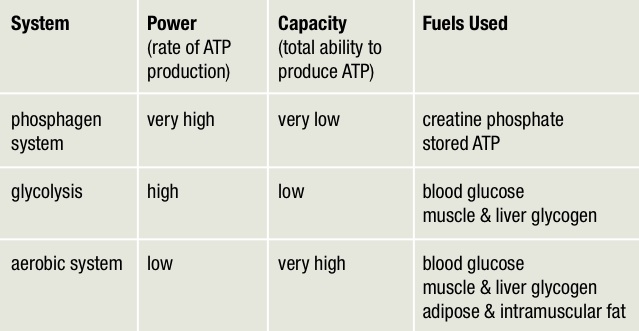
The aerobic system—which includes the Krebs cycle (also called the citric acid cycle or TCA cycle) and the electron transport chain—uses blood glucose, glycogen and fat as fuels to resynthesize ATP in the mitochondria of muscle cells (see the sidebar “Energy System Characteristics”). Given its location, the aerobic system is also called mitochondrial respiration. When using carbohydrate, glucose and glycogen are first metabolized through glycolysis, with the resulting pyruvate used to form acetyl-CoA, which enters the Krebs cycle. The electrons produced in the Krebs cycle are then transported through the electron transport chain, where ATP and water are produced (a process called oxidative phosphorylation) (Robergs & Roberts 1997). Complete oxidation of glucose via glycolysis, the Krebs cycle and the electron transport chain produces 36 molecules of ATP for every molecule of glucose broken down (Robergs & Roberts 1997). Thus, the aerobic system produces 18 times more ATP than does anaerobic glycolysis from each glucose molecule.
Fat, which is stored as triglyceride in adipose tissue underneath the skin and within skeletal muscles (calledintramuscular triglyceride), is the other major fuel for the aerobic system, and is the largest store of energy in the body. When using fat, triglycerides are first broken down into free fatty acids and glycerol (a process called lipolysis). The free fatty acids, which are composed of a long chain of carbon atoms, are transported to the muscle mitochondria, where the carbon atoms are used to produce acetyl-CoA (a process called beta-oxidation).
Following acetyl-CoA formation, fat metabolism is identical to carbohydrate metabolism, with acetyl-CoA entering the Krebs cycle and the electrons being transported to the electron transport chain to form ATP and water. The oxidation of free fatty acids yields many more ATP molecules than the oxidation of glucose or glycogen. For example, the oxidation of the fatty acid palmitate produces 129 molecules of ATP (Brooks et al. 2000). No wonder clients can sustain an aerobic activity longer than an anaerobic one!
Understanding how energy is produced for physical activity is important when it comes to programming exercise at the proper intensity and duration for your clients. So the next time your clients get done with a workout and think, “I have a lot of energy,” you’ll know exactly where they got it.
For the latest research, statistics, sample classes, and more, "Like" IDEA on Facebook here.
SIDEBAR: Energy System Characteristics
SIDEBAR: Energy System Workouts
Have clients warm up and cool down before and after each workout.
Phosphagen System
An effective workout for this system is short, very fast sprints on the treadmill or bike lasting 5–15 seconds with 3–5 minutes of rest between each. The long rest periods allow for complete replenishment of creatine phosphate in the muscles so it can be reused for the next interval.
  • 2 sets of 8 x 5 seconds at close to top speed with 3:00 passive rest and 5:00 rest between sets
  • 5 x 10 seconds at close to top speed with 3:00–4:00 passive rest
Glycolysis
This system can be trained using fast intervals lasting 30 seconds to 2 minutes with an active-recovery period twice as long as the work period (1:2 work-to-rest ratio).
  • 8–10 x 30 seconds fast with 1:00 active recovery
  • 4 x 1:30 fast with 3:00 active recovery
Aerobic System
While the phosphagen system and glycolysis are best trained with intervals, because those metabolic systems are emphasized only during high-intensity activities, the aerobic system can be trained with both continuous exercise and intervals.
  • 60 minutes at 70%–75% maximum heart rate
  • 15- to 20-minute tempo workout at lactate threshold intensity (about 80%–85% maximum heart rate)
  • 5 x 3:00 at 95%–100% maximum heart rate with 3:00 active recovery

Sunday, 29 June 2014

Underactive Thyroid (Hypothyroidism)

Thyroid function is intimately connected with your metabolism — thyroid hormones basically regulate calorie consumption. But a healthy thyroid also depends on the proper functioning of other body mechanisms, including your neurotransmitters, your reproductive hormones and your adrenal glands.

The thyroid and weight gain

Because patients with an underactive thyroid tend to have a very low basal metabolic rate, one of the most noticeable symptoms of hypothyroidism is weight gain and difficulty losing extra weight. (Sometimes an overactive thyroid can mimic an underactive thyroid by causing weight gain, although this is less common). A minority of women with hypothyroidism don’t gain weight. The difference arises from their individual biochemistry, the quality of the calories they consume, and how they use those calories.
 
Often the “metabolic burn” continues to fall as calories are reduced when dieting. That’s why some women with low thyroid can have weight gain even when they severely restrict calories. In order to fix your metabolism, you have to understand your entire health picture, not just your thyroid.

The thyroid in women

More women than men suffer from hypothyroidism, and many more women than men with thyroid issues have problems with weight gain. Most thyroid problems occur within the gland itself and often don’t reveal themselves until a broader pattern of hormonal imbalance develops. That’s why thyroid issues, menopause and weight gain often appear together.
Why do women experience low thyroid and weight gain with such frequency? The reasons are manifold, but primarily:
  • Women spend much of their lives dieting, usually in a yo-yo cycle of feasting and then fasting. This undermines your metabolism and decreases your metabolic rate, a compounding factor for the thyroid, especially during perimenopause.
  • Women tend to internalize stress, which affects their adrenal, brain, and thyroid function, resulting in increased cravings for sweets and simple carbs to provide instant energy and feel good hormones.
  • Women experience monthly hormonal fluctuations that affect their biochemistry.

What you can do about hypothyroidism and weight gain

The first thing to do if you are experiencing stubborn weight gain is to talk to your practitioner. She or he may ask for a thyroid test or measure TSH (thyroid stimulating hormone). I have found in my practice that many women who test within the “normal” range of traditional medical standards still need thyroid support. Their TSH may be only slightly elevated, but enough so that it influences their metabolism and causes weight gain.
For these women, supplemental nutrients such as selenium and a regular meal plan that balances a proper ratio of protein to carbohydrates increases their metabolic functioning and they begin to lose weight. In some cases, a low-dose thyroid replacement hormone is also needed.
There is a lot of controversy in the endocrinology world regarding hypothyroidism treatment. There are those that believe that patients who test within the normal range but have very low basal metabolic rates and very low basal temperatures need thyroid supplementation. There are others that argue that only patients with significant abnormalities should be supported with thyroid hormones.
 

You CAN lose weight with an under active Thyroid, but:

  • You may not lose weight at the same rate you did before.
  • You may not lose weight at the same rate as someone else.
  • You may not get back to the size you were.
Be realistic about your goals and objectives and realize that being a certain weight or size is not always the best goal when living with hypothyroidism. Having more energy and reducing feelings of fatigue and depression are usually more important to your quality of life.
We have an all natural supplement called Thyax that can help you deal with your under active thyroid. Click here for more information on our product.
 

When you are setting your goals, keep these things in mind:

  • Make lifestyle changes. Hypothyroidism will be with you for the rest of your life, so healthy eating, exercising and taking care of yourself must be priorities.
  • Make time for healthy eating and regular exercise. Commit to prepare food, exercise and take care of you. Put yourself on your to-do list each day.
  • Be optimistic and acknowledge the positive changes you have made–no matter how small. Journal about the highs and lows of the journey as an outlet for frustration and as a way to look back at your progress when the going gets tough.
  • Change doesn’t happen overnight. It takes small steps to get from where you are to where you want to be. Stays focused and take it slow. Do the best you can. Take a step further each day, pick yourself up when you stumble, and keep your eyes on the goal.
  • Few worthwhile outcomes are easy or quick. Be wary of the latest fad in weight loss or ploys for people with hypothyroidism.

Dietary Tips for weight loss with Hypothyroidism

  • Reduce your use of stimulants. When trying to fight fatigue, stimulants like caffeine may be a way of life. Hypothyroidism makes the adrenal glands susceptible to overwork and burnout. The adrenal glands can only take so much stimulation before they begin to under-function. Weaning off of stimulants, including coffee, soda and tea, can help the adrenal system heal and recharge.
  • Decrease the amount of carbohydrates you eat. Research shows that individuals with a low thyroid are more successful when eating slightly less–about 45-50% of total calories coming from carbs. Limiting your intake to the low end (about 50% carbs) will help you accomplish this. At 50% carbs, your diet will probably result in about 30% protein and 20% fat.
  • Choose more complex carbs. Enjoy plenty of fresh fruits, vegetables, and whole grains (whole wheat bread and pasta, brown rice, wheat germ). These foods are nutritionally superior to their refined counterparts.
  • Limit sugary (simple carbohydrate) foods such as pies, cakes, cookies, candy, soda, ice cream and chips. These foods stimulate high insulin production.
  • Avoid eating carbohydrates by themselves for meals or snacks. Be sure to include a protein source at the same time. Protein is digested more slowly, helping slow down the release of insulin.
  • Increase your fibre intake to 30-40 grams per day. People with hypothyroidism often experience sluggish digestion and constipation. A high-fibre diet can help move things along so to speak, while increasing satiety so that you never feel hungry. Be sure to slowly increase your fibre over time. To meet this goal, you may also need a fibre supplement such as Metamucil.
  • Drink 8-12 cups of water every day. Metabolism requires water, so not drinking enough will hurt your weight loss potential as well. When increasing your fibre intake 30-40 grams, water is even more important. Drink additional water to compensate for perspiration from exercise and hot weather.

Exercise & Other Considerations to help with weight loss

Hypothyroidism does cause weight gain–typically 10-20 pounds. Gaining more than 20 pounds can usually be attributed to fatigue that limits your activity, not to the disorder itself. When you feel fatigued, you don’t feel like exercising. This can lead to a vicious cycle since not exercising can result in greater fatigue and so on and so on. Physical activity and exercise are keys to weight control and to decreasing the affects of fatigue.
  • Get regular aerobic (cardio) exercise. Individuals with a low thyroid can have low levels of serotonin, the brain chemical involved in appetite control, depression, and sleep regulation. Just thirty minutes of aerobic (cardio) exercise, five times per week can help boost serotonin levels to decrease these symptoms.
  • Likewise, strength training helps increase metabolism, which is also suppressed in those that are hypothyroid. Although you may not have much energy initially, get moving! The more you move the more you can boost the energy you will have to exercise each day.
  • Reduce the stress in your life. Stress causes many people to make unwise food choices and overeat. Reactions to stress are controlled by the adrenal glands, which are overworked and under active thyroid in patients. Stress also increases cortisol levels, increasing hunger and affecting insulin levels. Reducing stress is an often overlooked factor in weight loss.
  • Practice deep breathing. Many times the increased weight and lack of physical fitness causes those with hypothyroidism to pant for air, taking shallow, short breaths. Deep breathing exercises can help you take in more oxygen and release more carbon dioxide with each breath and can help with weight loss, stress reduction, and relaxation.
Hypothyroidism is a life-long condition. With careful management, people with thyroid disease can live healthy, normal lives. The best way to take control of your thyroid health is to work with your medical provider to develop a treatment plan that includes nutrition, exercise, and stress relief.


This post can be found at Macro Man's Main Blog!


Soy vs Whey Protein

There is so much research and opinion on this one that you will find endless articles for both sides of the argument, if you read enough of them you can form your own opinion, where you will probably get to is that there really isn’t much difference!

Continuing the Soy Vs Whey debate. . .  
Both plant-based soy protein and whey protein from dairy milk have been shown to help build and maintain lean body mass. Although not as rapidly digested and absorbed by the body as whey protein, soy protein does help support lean muscle mass.
 
For many years, a score called Biological Value was used to measure the quality of protein. Whey generally scored much higher than soy because of its unique composition. However, more current research shows a more appropriate measure of the effectiveness of different types of protein in building and maintaining muscle is called the Protein Digestibility Corrected Amino Acid Score (PDCAAS).
 
Both soy and whey have a PDCAAS score of 1.0, which is the highest score available, the same as egg whites.
 
Your body needs protein for survival. Amino acids — the building blocks of protein — are necessary for everything from immune function, metabolism and weight management to muscle repair, growth, development and performance. There’s also research that shows protein helps you feel alert, as well as more satiated for a longer period of time.  The common types of protein powders fall into two categories: animal-based protein (casein, whey and egg) and plant-based protein (hemp, rice, pea, sacha inchi, potato, etc.).
 
soy whey 2
 
What are the differences between traditional whey protein and plant-based protein?  Whey protein is a by-product of the cheese manufacturing process and is the liquid that is left behind after milk is curdled and strained.   Since whey protein is derived from milk, lactose intolerance is one of the most common side effects from consuming whey protein.  Whey protein is a common allergen and can affect the immune system of individuals who may be allergic to it.  Whey proteins are also notorious for causing bloating which is a symptom of the body’s inability to digest it.  Symptoms related to digestive issues include abdominal pain, gas, bloating and diarrhea.  Whey protein is high in sulphur-based amino acids.  This means that whey protein is acid forming which can cause significant calcium loss and weakening of the bones known as osteoporosis.  Since over-consumption of whey protein leads to increased acidity and lowered pH of the blood, it is believed that this may give rise to various kidney disorders.
 
This graph shows why our H24 products combine Soy & Whey to get the best possible results!
 
Plant-based protein, on the other hand, is a much easier digestible source of protein for humans without the side effects associated with whey protein. Plant protein is perfectly packaged along with an abundance of phytonutrients, antioxidants, vitamins, minerals, and fibre —all critical components for optimal health and disease prevention.  Blended plant-based protein provides a full spectrum of amino acids through complementary sources and is alkaline forming in the body.
 
soy whey
 
This article can be found at Macro Man's Main Blog!
 

Wednesday, 25 June 2014

3 Tips For Optimal Health


Public health is a huge concern of almost everyone in one way or another.  Everyone should try to optimise their own health. Nothing frustrates me more than seeing people struggle with their appearance, mood, mental clarity and energy to name but a few. At the same time their body fat levels show that they are borderline morbidly obese. Doesn’t it strike you as coincidental that more often than not it is fat, overweight people who rarely exercise and eat an inordinate amount of crappy unhealthy food are the one’s with appearance, mood, cognitive, energy and libido issues? More often than not it is these people who are chronically fatigued.  We are supposed to live until 100 years old not suffer from inordinate amounts of disease after just 20 years of life; we all need to work on creating an environment for optimal health.
I experienced parenthood for the last two days and I enjoyed it.  Of course I’m not trying to undermine how difficult it must be to rear kids but I will say that being highly active and eating a good, healthy diet played a big role in why my energy wasn’t zapped. Sleeping in is a luxury for parents with kids of school going age and I am under no illusion that the effects of being a real parent may accumulate over time but eating well and fitting in some exercise when you can will have a profound effect on your ability to stay healthy, energetic and keep in good shape.  Most parents health status is far below optimal I would imagine.
Do you wake up and feel groggy every morning?  Do you claim to need a coffee to get you going?  Do you dread the thought of getting out of bed?  If you answered yes to any of these then you need to make a change (Chek, 2009).
More often than not the reasons for these issues are so obvious it will make you sick. You could be eating foods that don’t work well with your body, not sleeping enough, not exercising, not exercising properly or under a lot of stress.  We are not all designed to eat the same types of food.  As an example; different cars take different types of fuel, right?  What makes you any different to a car?  Fill your body with the wrong type of fuel and it will tell you.  Just because you don’t break out in hives doesn’t mean all food is good for your body. Fatigue is the #1 example of how we react badly to different foods. Do you feel a little sluggish after a particular meal?  If so you will be best served to avoid it.  In my case pasta makes me extremely tired almost immediately after eating it.  Large amounts of low fibre carbohydrates in one sitting generally make me feel bloated and sluggish.  These are my body’s way of telling me it doesn’t want these foods (Chek, 2009).
Handstand Press Up Outdoors

Do You Get Enough Sleep?

Most people underestimate the value of adequate sleep and most people tend not to get enough sleep as it is. For optimal body function you need between 7-9 hours of sleep each night.  You may be saying to yourself you get enough sleep but just because you spend 7-9 hours in bed doesn’t necessarily mean you are getting quality sleep.  Sleep quality is far more important than sleep quantity.  You should not feel groggy after 7-9 hours in bed (Wilson, 2006; Chek, 2009; Holford, 2012).  You should wake up without an alarm and want to get at the day.  Fatigue can induce impaired gluconeogenesis (your body’s ability to use fat and protein for energy), rapid hypoglycemia (low blood sugar), sodium loss and potassium retention (Wilson, 2006). What’s interesting about this situation is due to the stress your body is under, despite having low blood sugar, there tends to be rather high levels of blood insulin meaning you are going to become progressively more overweight and at risk of type 2 diabetes. The net result of these is a miserable, tired feeling.  Small things can make an inordinate amount of difference in the quality of your sleep;
  1. Turn off all electronics.  Yes this includes your phone.  With the advancements in phones of late almost everybody has some sort of notification waiting for them every morning be it from email, twitter, instagram or your ‘hardcore’ friends posting annoying late night Facebook updates and photos.  If you leave your phone on at night your are more likely to be woken.  Turn it off, whatever it is can wait until the morning.  For those of you that use your phones as alarm clocks Invest in an alarm clock (preferably a battery-powered one) (Gooley et al. 2011;Chek, 2009).
  2. Have no lights shining.  That even means covering the red LED from your alarm clock. Get curtains that leave the room in complete darkness.  You may not think it but light from the night sky also affects your sleep quality.  I can never understand how people can sleep without drawing their curtains (I have a few people in mind) (Gooley et al. 2011; Chek, 2009).
  3. Stop playing video games or doing anything that gives your brain a lot of stimulation. You should be winding down an hour before bed.  Ever find that your brain won’t stop going when all you want to do is sleep?  Try and read before bed and dump all your work or college thoughts until the next day. Many people worry about what they have to do tomorrow.  A good technique I have starting doing lately is making a list of everything I have to do in order of priority in the evening.  It is often referred to as a ‘brain dump’, it helps you to forget about what has to be done until the morning (Chek, 2009).
  4. Have a cool room temperature.  This one might sound a bit ridiculous to some of you.  A cold room is far more conducive to high quality sleep than a warm room.  Your body temperature naturally drops through the night. The cooler your body is the better your sleep will be. Try taking a cold shower before bed. This is ideal for anybody that works out late at night.  And no you shouldn’t be wearing socks and a hoody to bed that’s just downright ridiculous.  Unless you live in a house with below freezing temperatures, then you should wear a hat to bed, I’m speaking from experience here from my poor student days.
  5. Eliminate caffeine after 3pm.  I am a culprit for this one myself.  You may think having a coffee after your dinner is not problem as you fall asleep just fine. Again, I come back to the sleep quality issue. You may fall asleep easily but caffeine is a stimulant and will in fact continue to stimulate your central nervous system throughout the night this upsetting your sleep quality (Chek, 2009).
  6. Eliminate high carbohydrate meals 3 hours before bedtime. Remember that carbohydrates cause a large spike in blood sugar which in turn gives you a boost in energy.  Try a moderate protein and fat meal is you want to eat close to bedtime (Richards, 2005).
  7. Go to bed earlier.  Midnight is not a good time to go to bed.  You should be sound asleep by 10.30 at night (Richards, 2005). 

Female sleeping

    Exercise

    Find me someone who exercises PROPERLY and eats relatively well that doesn’t feel good.  Unless they have some other underlying health issue then you won’t find one. Even if you do think you find someone you will never know unless they change their diet and exercise regime to see if it makes them feel better.With regard to exercise let me clarify from the beginning; walking is not exercise, it’s locomotion, meaning it’s something you have to do for life.  If you feel like crap, are tired don’t think walking will fix your problem. Granted it has it’s place for overall longevity but for health & fitness purposes you may as well just stay in bed if walking if your medicine. For those that are short on time, all you need is 10-15 minutes a few days each week. Everyone has this time; it;s just a matter of allocating it to exercise.  You may feel like you don’t want to exercise but you have to force yourself at the beginning.  Examples of the initial benefits for those with chronic fatigue and health complications include (Wilson, 2003; Harrower HR. 1922);

    1. Increased blood flow which helps prevent plaque accumulation in your arteries and stimulates your liver which enables it to perform its 3000+ daily functions more effectively
    2. Exercise will also help to normalise cortisol, insulin, blood glucose, growth hormone, thyroid hormones among others
    3. Drives oxygen to your brain.
    Do some HIIT at home e.g. pick an exercise like burpees, mountain climbers, squat jumps etc, do it as fast as possible for 15-30 seconds, rest for the same time and repeat for 10-12 minutes. Try it out and tell me it was easy.


    Diet

    Your diet is the overall key.  Reduce or eliminate sugary foods e.g. biscuits, cakes, sweets, ice cream, pastries.  Also eliminate poor carbohydrate sources like pasta, white rice, almost all breakfast cereals and most breads (except spelt or rye for example) (Pollan, 2008). Base your meals around proteins such as; chicken, turkey, salmon, tuna, herring, mackerel to name but a few, include a large base of vegetables and highly fibrous, slow releasing carbohydrates such as; quinoa, oatmeal, beans, brown rice, basmati rice and cous cous (Taubes, 2009).  If your main meals are in check then you will see and feel amazing improvements. Make small changes at first and build on them over time rather than instantly changing your entire diet.  Remember that you must aim to eat REAL FOOD.  Things with wrappers and more than three ingredients aren’t food rather they are diseases disguised as food (Gussow, 2003).  Check out this recipe site, that shows you how to cook healthy versions of your favourite desserts.

    Closing Thoughts

    Make some of these changes to your life, you will reap the rewards.  Remember, nobody is asking you to be perfect.  Just make small changes and you will see the benefits.
    1. Sleep Better
    2. Exercise Smarter
    3. Eat Better
    4. Eliminate Needless Stressors in Your Life (This basically encompasses every one of the above four points)

Review: Misfit Shine

Misfit Shine
Key Features: Bluetooth 4.0 LE; Waterproof to 50m; Multiple sports tracked; 4-month battery life; No charging or wires required
Manufacturer: Misfit Wearables

Misfit Shine review

What is the Misfit Shine?

The Misfit Shine enters a rather crowded fitness tracking market with a selling point that will stand it apart from the competition – it’s fully waterproof. It’s also an attractive all-metal disc that can be worn anywhere on your body using a dinky little magnetic strip that holds the Misfit Shine in place.

It was launched as an IndieGoGo campaign and achieved its $100,000 project goal 9 ½ hours after it launched. At close, the Misfit Shine had raised its goal eight and a half times over, which just goes to show how interesting the device is.

But can the £99 fitness tracker stand out against its popular rivals?


Misfit Shine Boxed

Misfit Shine – Design and Features

One of the most striking things about the Misfit Shine is its design. Made from aerospace grade aluminium with a distinct groove running around the middle for using the Misfit Shine’s various accessories, it is small, light and compact. Misfit’s choice of material means the Shine only weighs 9g on its own, or 16g with the included wrist strap.

The company, Misfit Wearables, is co-founded by former Apple CEO John Sculley, and there is definitely a touch of Apple in the design of the Shine, especially its simplicity and clean lines. 

Misfit has made sure the Shine can be worn anywhere on the body, and even supplies both the sports band and clasp as standard with the Misfit Shine in the UK from John Lewis. The clasp is a rubber loop with a magnet on one end that folds over to couple with the back of the Shine. You can attach this to any item of clothing, even a swimsuit or shorts as it is completely waterproof to 50 metres. This is also pretty handy if you forget to remove it from your clothes and it happens to take a washing machine trip.

The sportsband is a rubber watch strap that the Misfit Shine simply pops into and is designed to look much more like jewellery than your average fitness tracker, which is one of its key benefits. There’s also a leather strap and a necklace option to purchase separately if you feel the need.

Its waterproof nature and the fact it is so very light means you can pretty much forget about the Misfit Shine when you’re wearing it, especially when it’s strapped to your wrist.

However, it is useful to remember, any fitness tracker worn on your wrist isn’t going to be as accurate as one worn on your clothing as you tend to move your arms more than any other limbs, or you could stop moving them altogether, such as when you’re gripping a bag strap – both of which can cause inaccurate results. This is why Misfit includes the clasp for attaching the Shine to your clothing, which is especially useful when at the gym.

Misfit Shine clipped onto a t shirt

When in sleep mode, the Misfit Shine looks like it has no display at all, but with a double tap on its face you’ll be presented with a ring of LED lights around the edge, which are used to indicate your current goal progress and the time. 

Each LED light is an interval of five minutes or 5 per cent completion of your customised goal. It can be a little difficult at first to work out what time it is (the hour is a solid LED but the minute indicator flashes), but you soon get used to it. Your goal progress is shown in a ring that runs clockwise with your sporting activity until the whole ring of lights is completed, which is a simple but effective way to keep tabs on it without having to look at the app. 

On the rear of the Misfit Shine is a handy 12 logo, to show you which way up the fitness tracker should be placed in your watch strap for accurate clock readings. 

The Misfit Shine connects to the Shine app for iOS devices via Bluetooth 4.0 LE, which doesn’t require pairing. Misfit assures us there’s an Android app coming “in the next few weeks”, but there hasn’t been any joy there as yet.

Bluetooth LE keeps the power consumption low and combined with the fact the Misfit Shine uses a standard cell watch battery with a battery life of at least 4 months, you’ll be using it for ages without having to charge it or replace the battery.

There are some features that are lacking in the Misfit Shine, like an altimeter to count the number of stairs you climb, which features in upcoming trackers like the Fitbit Force.


Misfit Shine – Tracking and Apps

The Shine app is a very simple but effective way of monitoring your daily fitness activity. Periods of activity are shown in colour coded panels that show the type of sport you are doing and low, medium and energetic patches of activity.

There’s a highlights panel that offers you a look at your daily milestones, broken down into a handy activity chart and the aforementioned coloured blocks. You can also take a look at a weekly overview of your activity, which also compares your achievements to the previous weeks. 

Overall, the Misfit Shine is very accurate and can tell when you are performing any of its recognised activities – walking, running, cycling or swimming. It does tend to be far more precise when worn on your clothes, as when on your wrist it can suggest you were more active than you actually were – but that sometimes isn’t a bad thing.

Within the app you can not only personalise your activity goal, but also let it know where you’re wearing the Misfit Shine for more precise data gathering and whether you want the fitness tracker to display the clock or progression lights first. 

You can also utilise the Misfit Labs Activity Tagging. This allows you to triple tap the Misfit Shine to tell it you are doing a specific activity for more accurate readings. Although this feature is still in Beta, you can use it to tell the Shine when you’re sleeping, cycling, swimming, playing tennis, basketball or football and the results are far more accurate – if you remember to triple tap before you start doing them. 


Misfit App Screenshots

The Shine app also presents information on the amount of steps you’ve taken, calories burnt and distance covered in a single day or whole week. 

What is disappointing about the Misift Shine is its sleep monitoring functionality. Unless you tell it you’re going to sleep using the Activity Tagging it won’t monitor your sleep pattern whatsoever. We always forgot to triple tap before we fell asleep so we’d wake up with no data for our slumber. 

When you do remember, it lets you know how many hours of deep sleep you’ve managed to get in between patches of tossing and turning. How accurate this data actually is is very hard to calculate, but they are interesting statistics to peruse in the morning.

As the Misfit Shine uses Bluetooth LE you won’t need to pair it with your smartphone or tablet. When you enter the app, the data automatically updates and fills in all the fitness tracking information since you last logged in. it doesn’t matter whether that’s a week or 5 minutes ago, it is all updated regardless. 

It is very speedy to update, which is a bonus. We will say the data provided is a bit limited, but that’s pretty standard for what is basically a glorified pedometer like its competition. The app is laid out in a straightforward and accessible way and unless you’re a proper fitness freak it is more than sufficient for those looking to monitor their activity.

Misfit App Screenshots

Should I buy the Misfit Shine?

The Misfit Shine is a great activity tracker but is a little more expensive than some of its competitors and currently has limited smartphone and tablet compatibility if you don’t have an iPhone or iPad. It’s still a strong contender, but you might still want to consider some of the alternatives.

At £79.99, the Fitbit Flex is another successful fitness tracker that offers a great app, a 4 – 5 day battery life and is water resistant if not entirely waterproof. It is a bit basic though and lacks a full display, altimeter and can’t even tell the time by itself. It works with (select) Android devices as well as iOS though.

At the top end of the price bracket is the £99.99 Nike Fuelband that is specifically optimised for Apple’s device range. It uses Bluetooth LE and is now water resistant and more flexible for a more rugged device. It can offer a lot more information on your wrist than the Misfit Shine, but still lacks an altimeter.

The Jawbone UP works with iOS and Android devices and is around the same price as the Misfit Shine at £79.95. It offers detailed feedback via an app and has a vibrating alarm function alongside sleep monitoring. You can even take pictures of your meal to convert it into calories with the Jawbone UP.

Verdict

If you’re looking for a fully-functional and completely waterproof fitness tracker, the Misfit Shine is a great choice, especially for the fashion conscious. The lengthy battery life just sweetens the deal.

What's Popular Now